In this article
Mini split heat in winter works well in North Jersey if you set the unit correctly, keep the outdoor unit clear, and know what your model can handle. Use Heat mode at one steady temperature, avoid deep setbacks, and never cover the outdoor unit while it runs. Whether it can carry your whole house through January depends on whether it is a cold-climate model.
Can a mini split heat your home all winter?
A mini split is a heat pump. ENERGY STAR explains that the outside unit pulls heat from the outdoor air, even when it's cold. As temperatures drop, pressure and refrigerant flow fall, and so does heating output, right when your house needs the most heat.
Whether it can be your only heat depends on:
- The model. Cold-climate units hold more capacity in deep cold.
- The coverage. One head in an addition heats that room, not closed-off bedrooms across the house.
- The house. Drafty, poorly insulated rooms may need more heat than the unit delivers on the worst days.
If you still have a boiler or furnace, keep it serviced. It covers the coldest stretches, rooms the heads don't reach, and a breakdown during a cold snap.
How to check if you have a cold-climate model
- Find the model number on the outdoor unit's label or in your installation paperwork.
- Look it up on the NEEP cold climate air-source heat pump list, a database of extended capacity data across many manufacturers.
- If it isn't listed, check the manufacturer's spec sheet for heating capacity at low outdoor temperatures. If that figure is missing, plan on backup for very cold days.
Best mini split winter settings
Heat mode vs. Auto
Advice online conflicts because the modes suit different seasons. Auto switches between heating and cooling to hold a setpoint, which helps in spring and fall when cold mornings turn into warm afternoons. In midwinter that switching gains nothing, and a sunny room can trigger brief cooling. From about December through February, pick Heat and leave it.
What temperature to set
Pick a comfortable temperature, often the upper 60s to low 70s, and stop adjusting it. An inverter mini split is most efficient running steadily at low speed; each bump in setpoint makes it ramp to high output.
Leave it running, set it back, or turn it off?
- Overnight: A setback of a few degrees is fine. A deep setback forces full-output recovery in the early morning, when it's coldest and the unit has the least capacity.
- Off entirely: If it's a room's only heat, don't shut it off. The room cools and takes a long time to recover.
- Vacation or empty house: Leave it in Heat at a lower temperature to protect pipes in exterior walls. Some models have a low-temperature maintenance mode; check your manual. Keep any boiler or furnace set as a safety net.
Snow, ice and the outdoor unit
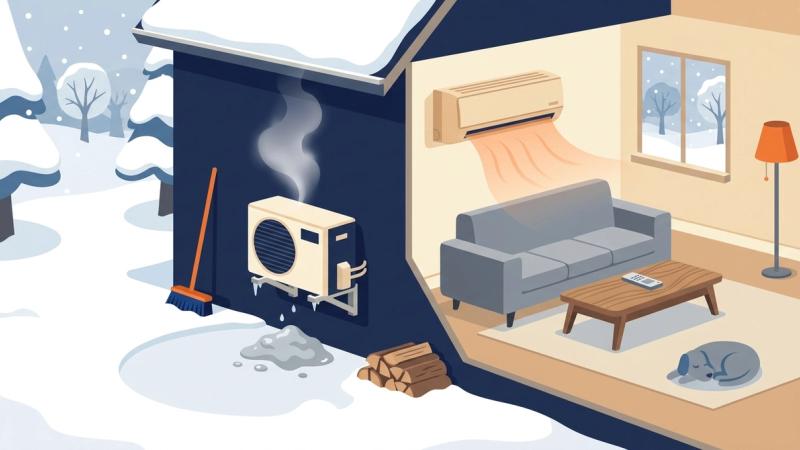
Don't cover the outdoor unit while it's heating. It needs open airflow across the coil. Use only a snow hood the manufacturer approves for your model.
- After a storm, brush snow off the top and sides and keep the clearances listed in your unit's installation manual.
- Never chip ice off the coil with a shovel or scraper; the fins and tubing puncture easily.
- Defrost water drips from the unit and can refreeze into a mound underneath or an icy walkway. A wall bracket or raised stand keeps the unit above snow and gives the drip somewhere to go. If the base pan or drain keeps freezing solid, have it checked.
Why it pauses or puffs steam
In cold, damp weather, frost builds on the outdoor coil, so the unit stops heating for a few minutes to melt it. The indoor fan may stop and steam may rise outside. That's normal defrost.
When mini split heat in winter falls short
What you can check yourself
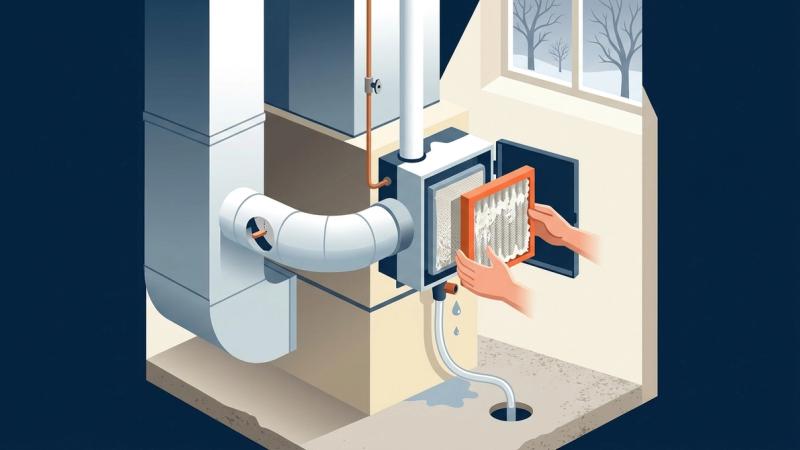
- Filters: Rinse the indoor head's mesh filters if they're dusty; clogged filters commonly cause weak airflow. Our filter replacement service can handle it for you.
- The remote: Confirm Heat mode (not Cool, Dry or Fan), a setpoint above room temperature, and fresh batteries.
- The outdoor unit: Make sure snow, a plow drift or ice isn't blocking it.
What needs a licensed technician
- Ice that stays on the coil after several defrost cycles
- Blinking lights or error codes on the indoor head
- Weak or lukewarm air with clean filters, which can mean low refrigerant, a drain problem or a faulty sensor
- The unit running nonstop while the room gets colder
Low refrigerant means a leak, and topping it off doesn't fix that, so it calls for refrigerant leak repair. For homes in Parsippany-Troy Hills, our licensed, background-checked technicians service ductless mini split systems and can tell you whether an older unit is worth repairing. Yearly HVAC maintenance and tune-ups catch drain and coil problems before cold weather exposes them.
Frequently asked questions
Should I turn off my mini split in winter?
Not if it heats a room you use or protects pipes. Keep it in Heat mode with modest setbacks.
Is it normal for the outdoor unit to stop and steam?
Yes. That's defrost, and heat resumes within minutes. Call for service if ice stays on the coil afterward.
Can an older, non-cold-climate unit handle January?
It will heat, but with less output in deep cold. Plan on a boiler, furnace or other backup for the coldest days.
Need Air Conditioning Service in Parsippany-Troy Hills, NJ?
Call Heights Plumbing, Heating & Cooling at (201) 245-7772 or schedule online today!
Schedule Service