In this article
Planning to cover AC unit in winter? In most cases, skip the full wrap. A full cover traps moisture inside the cabinet, which leads to rust and gives rodents a sheltered place to nest. A breathable top-only cover can help in some spots, and a heat pump should never be covered. The breaker is a separate decision, and if you turn it off, you need a plan for spring. Here's how to handle all three for a Branchburg home in November.
First, find out whether you have an AC or a heat pump
That answer decides everything else. An AC-only condenser sits idle until spring. A heat pump looks almost the same but heats your home in winter, so it has to breathe and shed ice all season.
- Check your heating system. If you heat with a gas or oil furnace or a boiler and the outdoor unit stays silent all winter, it's almost certainly an AC condenser.
- Check the thermostat. "Emergency Heat" or "Aux Heat" settings usually mean a heat pump.
- Watch it on a cold day. If the outdoor fan runs while the heat is on, or the unit puffs steam during a defrost cycle, it's a heat pump.
- Read the nameplate. The label often says "heat pump." A technician can confirm it from the model number.
If it's a heat pump, skip the cover and breaker steps. Just keep it clear of snow, ice and leaves.
How to cover an AC unit in winter, if at all
Lennox's guidance says condensers are built to sit outside and full covers do more harm than good: they hold condensation against the coil and cabinet and make a warm nest for mice.
When a top-only cover makes sense
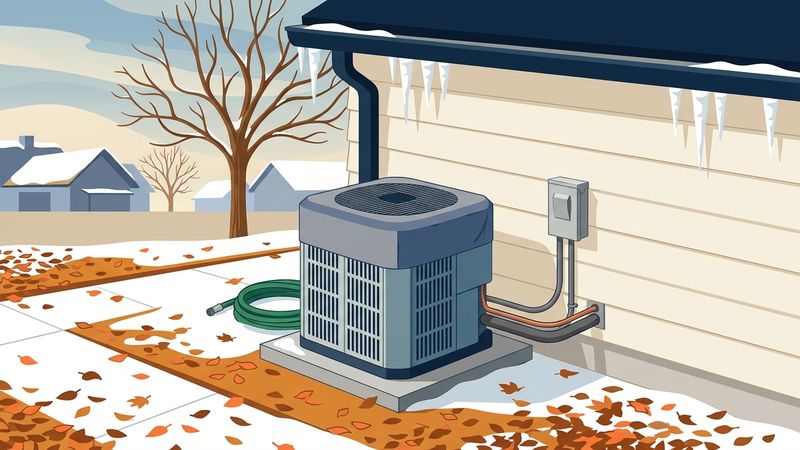
A breathable cover over the top grille keeps leaves, ice and roof drip out of the fan opening while leaving the sides open to air. It's most useful if the unit sits under a roof edge without a gutter, under a deck, or beneath trees. Branchburg's wooded lots and Somerset County freeze-thaw cycles make those spots common.
What to avoid
- Plastic tarps or wraps that reach the ground
- Anything tight enough to trap moisture
- A cover you might forget to remove before the first cooling day
Should you turn off the AC breaker in winter?
You can, but it's optional.
What the crankcase heater does
Many compressors have a crankcase heater that keeps the compressor oil warm whenever the unit has power, so refrigerant doesn't settle into the oil in cold weather. It uses some electricity all winter, which is why some homeowners shut off the breaker or outdoor disconnect.
The trade-off
- Leaving power on keeps the oil warm and the unit ready, at the cost of the heater's standby power.
- Turning power off saves that electricity and stops the AC from starting if someone sets the thermostat to "Cool" on a cold day, which can damage the compressor.
Turning it back on in spring
Turn the breaker or disconnect back on at least 24 to 48 hours before you first run the AC, so the heater can warm the oil and it doesn't foam at startup. Set a reminder for late April or early May.
Your November checklist to winterize the outdoor AC unit
- Clear leaves and debris from the base and top grille, keeping about two feet of clearance around the cabinet.
- Rinse the coil gently with a garden hose, with the power off. ENERGY STAR notes that dirty condenser coils reduce cooling. Never use a pressure washer.
- Check that the pad is level. A tilted pad stresses the refrigerant lines.
- Look at the line insulation on the larger copper pipe. It should be intact, not cracked, chewed or missing.
- Plan for snow and roof drip. Don't pile shoveled snow against the unit, and fix gutters that pour onto it. Ice falling from a roof edge can crush the grille and bend the fan.
Damage that needs a condenser repair visit before spring
November is a good time to spot problems while there's no rush. Call for AC condenser repair if you see:
- Bent or flattened fins across large areas of the coil
- Damaged or missing line insulation
- Oily spots on the coil, fittings or ground, a possible leak that needs refrigerant leak repair
- A rusted cabinet or base, or a unit that has settled out of level
- Signs of rodents: droppings, nesting material or chewed wiring
- An AC that came on in cold weather, which may point to a thermostat or control problem
Don't open the electrical panel yourself. A licensed technician can inspect it, and a spring HVAC tune-up is the right time to confirm the system is ready for cooling season.
Frequently asked questions
Should I cover my AC unit in winter?
Not with a full cover, which traps moisture and invites rodents. A breathable top-only cover can help if the unit sits under a roof edge or trees.
Can I cover a heat pump in winter?
No. A heat pump runs all winter and needs open airflow and room to defrost. Just keep it clear of snow and ice.
When should I turn the AC breaker back on?
At least 24 to 48 hours before you first run the AC, so the crankcase heater can warm the compressor oil.
Need Air Conditioning Service in Branchburg, NJ?
Call Heights Plumbing, Heating & Cooling at (201) 245-7772 or schedule online today!
Schedule Service