In this article
Knowing when to replace water softener equipment starts with ruling out the cheap problems. Many softeners that "stop working" have a salt bridge, a bypass valve left open, or a timer that reset after a power outage. Replacement makes sense when the resin is worn out, the control valve is failing on an older unit, or the system was never sized for your water. In Hampton Township, where homes run on private wells or Veolia's small public system, the answer also depends on what is actually in your water.
Why your water is still hard with salt in the tank
A softener passes water through resin beads that trade hardness minerals for sodium. During regeneration, the valve draws brine from the salt tank to recharge the resin. If any step breaks, the unit can look busy and still deliver hard water. Watch the salt level for a couple of weeks:
- Salt isn't dropping: the softener isn't drawing brine. Suspect a salt bridge, a clogged injector or a blocked drain line.
- Salt is used but water stays hard: the hardness setting may be wrong, the bypass may be open, or the resin may be worn or fouled.
Simple checks you can do yourself
Break a salt bridge
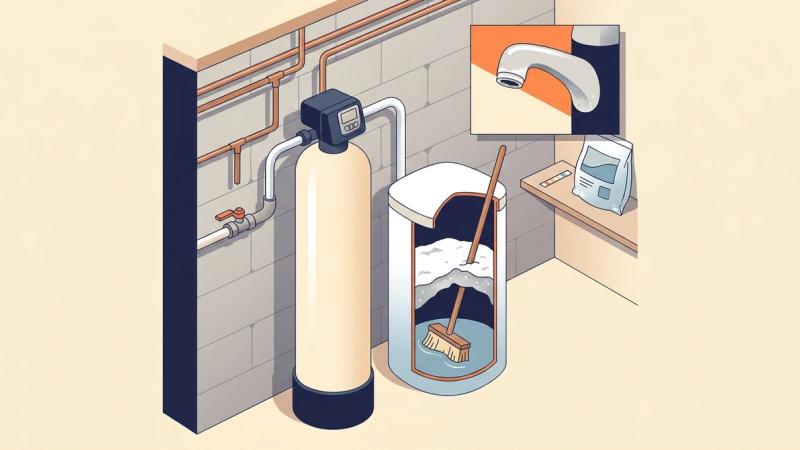
A salt bridge is a hard crust that forms in the brine tank, often from humidity or the wrong salt. The tank looks full, but there's an empty gap underneath, so no brine forms. Push a broom handle gently down through the salt. If it stops on a hard layer, tap the crust until it breaks apart. Don't use anything sharp or swing hard, or you can crack the tank. Mushy sludge at the bottom can also block brine draw.
Confirm the bypass valve
If the bypass was left engaged after service, the whole house gets untreated water. Make sure it's in the service position.
Reset settings after a power outage
Older timer-based units can lose the time of day and regenerate at the wrong hour or not at all. Reset the clock and confirm the hardness and regeneration settings.
Use softener salt and test the result
Use salt made for softeners and keep the level steady. Then compare a hardness test strip from a kitchen tap with one from an outdoor spigot, which is often unsoftened. Matching readings mean the softener isn't doing its job.
Resin bed, control valve or injector?
- Worn or fouled resin: the unit regenerates and uses salt, but soft water runs out fast or never shows up. Iron in well water and chlorine in treated water both shorten resin life. Beads in faucet aerators or the toilet tank can point to a broken internal part.
- Failing control valve: the unit won't start or finish a regeneration, runs water to the drain constantly, sticks in one cycle, or shows error codes.
- Clogged injector or drain line: water in the brine tank keeps rising, or salt sits untouched with no bridge. The injector is a small part that creates suction to pull brine, and sediment can block it.
When to replace a water softener instead of repairing it
Published lifespan estimates run from about 10 to 25 years, and the spread is real. A unit treating very hard, iron-heavy well water with spotty maintenance wears out sooner than one on moderate water that gets regular care. Judge by condition, not age:
- Repair or re-bed when the tank and valve are sound, parts are available, and only the resin or one component has failed.
- Replace when the valve is failing on an older unit, parts are hard to find, tanks are cracked, or repairs keep stacking up.
- Resize when your household grew, your water changed, or soft water runs out between regenerations.
Is your softener set for your water? Well vs. Veolia
Veolia Water New Jersey's Hampton system draws on groundwater. If you're on that system, check Veolia's annual water quality report or ask the utility for the hardness figure to program into your softener. Private well water varies from house to house, so only a test tells you your hardness and iron levels.
If you bought a home with a well, New Jersey's Private Well Testing Act required the untreated water to be tested when the home was sold. Pull those results before adjusting or replacing a softener, and retest if they're several years old.
What a softener won't fix
A softener treats hardness. It does not remove bacteria, arsenic or PFAS. According to the NJ Department of Health's Hampton Township profile, 6.5% of Hampton wells sampled under the act from 2002 to 2018 had at least one drinking-water exceedance, including fecal coliform in 5.4% and arsenic in 0.9%. If your test flags any of these, you'll need water filtration or other treatment alongside the softener. Our PFAS well water filter guide covers that side.
When to call a licensed plumber
Salt, settings and the bypass position are homeowner jobs. Call a pro for:
- A leaking or seized bypass valve, or a control valve replacement
- Drain line problems or rerouting
- Resin replacement or internal repairs
- Sizing and installing a new unit around your test results
Our licensed technicians handle water softener repair and replacement with upfront pricing, so you'll know whether a repair or a new unit makes more sense before work starts.
Frequently asked questions
How long does a water softener last?
Published estimates range from about 10 to 25 years. Hardness, iron content and maintenance decide where yours falls, so judge it by performance rather than age alone.
Can I just replace the resin?
Yes, if the tank and control valve are in good shape and parts are available. If the valve is also aging or the unit is undersized, a full replacement is usually the better value.
Will a softener make my well water safe to drink?
No. A softener only reduces hardness minerals. Bacteria, arsenic and PFAS need testing and separate treatment.
Need Plumbing Service in Hampton Township, NJ?
Call Heights Plumbing, Heating & Cooling at (201) 245-7772 or schedule online today!
Schedule Service