In this article
If your central AC needed refrigerant again this summer, or your fall tune-up found a leak at the indoor coil, the evaporator coil leak repair or replace decision comes down to three things: the system's age, its warranty status and how well a new coil matches the outdoor unit. On most R-410A systems, a real coil leak is fixed by replacing the coil, and that is still allowed in 2026.
Leaking evaporator coil signs (and how to know it's the coil)
An AC's refrigerant circuit is sealed. If it needs a top-off, it is leaking somewhere: the indoor coil, the outdoor unit or the copper line set between them. Common signs:
- The AC needs refrigerant every year, or even mid-season
- Ice on the indoor coil or the larger insulated copper suction line
- Long run times and a house that never reaches the thermostat setting
- Weak or lukewarm air from the vents
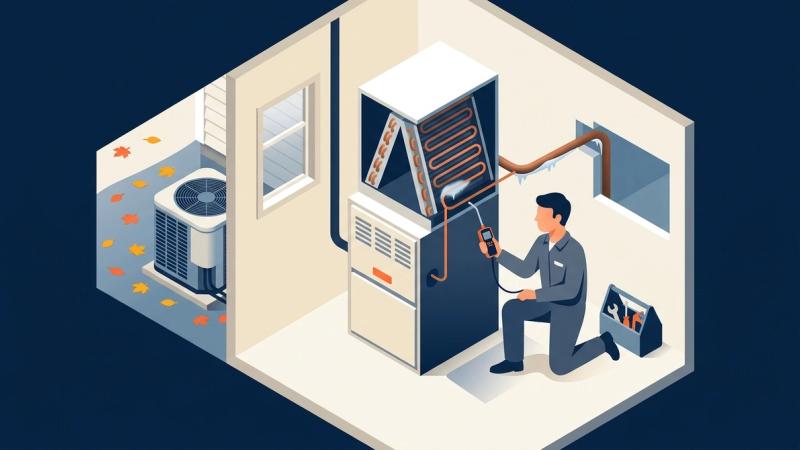
These symptoms show refrigerant is low, not where it's going. Pinning the leak on the coil takes a technician with an electronic leak detector and a nitrogen pressure test that isolates the coil, outdoor unit and line set, so you don't pay to replace the wrong part. That testing is the core of our AC refrigerant leak repair service.
What you can safely check yourself
- The filter. A clogged filter also causes icing and weak airflow. See our AC filter replacement page.
- Frost on the copper line. Note where it is, don't chip at it, and switch the system off to thaw.
- The drain pan and condensate line. Standing water or a clog is a drainage problem, not a refrigerant leak.
- The outdoor unit's data plate. It shows the manufacture date and refrigerant type.
- Your paperwork. Find the install date and whether the equipment was registered for warranty.
What to leave alone
Don't connect gauges, add refrigerant or open sealed coil panels. Handling refrigerant requires EPA certification, and topping off a leaking system only hides the problem.
Why evaporator coils leak
- Formicary corrosion. Named for its "ant-nest" pattern, it eats microscopic tunnels through copper tubing. Trade press has reported it across all manufacturers.
- Pinholes. General corrosion thins the tubing until tiny holes open.
- Vibration and stress. Leaks often form where tubes pass through the tube sheets at each end of the coil, or at the U-shaped return bends.
Can an evaporator coil leak be repaired?
Sometimes. A single leak at an accessible return bend or fitting can often be brazed. Leaks near the tube sheets or inside the finned section mean cutting away metal, and depending on location the repair may be extremely difficult or impossible. Formicary corrosion rarely makes just one hole, so fixing one leak often leaves others close behind.
We don't recommend leak sealant for a corroding coil. It can't restore tubing that is thinning throughout, and it puts an unknown substance into a system a technician will work on later. In most cases, a new coil is the repair that lasts.
Replace the evaporator coil or the whole AC?
The 2025–2026 refrigerant rules
New systems now use lower-GWP refrigerants such as R-454B, but existing R-410A systems aren't stranded. The EPA's HFC phasedown FAQ says homeowners can maintain and repair their systems throughout the equipment's useful life, including replacing a faulty indoor coil with a similar R-410A component. R-410A condensing units imported after January 1, 2025 can only be used to repair existing R-410A systems.
An R-454B coil is not a drop-in
You can't put an R-454B coil on an R-410A system to get ahead of the change. Carrier's R-454B FAQ states its R-454B refrigerant is not a drop-in replacement for R-410A. The new coil has to match your system's refrigerant.
How age, warranty and match tip the decision
- Newer system, under warranty: a matched R-410A coil is usually the sensible fix.
- Older system near the end of its life: a new coil on an aging outdoor unit can leave you facing a compressor failure soon after. A full air conditioning replacement handles everything in one project.
- Efficiency match: SEER2 ratings apply to specific indoor and outdoor combinations. A mismatched coil can cost capacity and efficiency, so confirm the replacement is an approved match.
Our evaporator coil services page explains how we size and match coils for either path.
Why October is the time to decide
In a gas-furnace system, furnace heat doesn't rely on refrigerant, so your heat keeps working while you weigh options. A heat pump is different: the same coil and refrigerant circuit make your heat, so a leak needs attention before winter. Either way, fall scheduling is flexible, and you avoid finding an empty system on the first hot day in June. For homeowners in Park Ridge, a coil or system swap now means cooling is ready well before next season.
When it has to be a licensed pro
Recovering refrigerant, brazing with a nitrogen purge, pulling a deep vacuum and setting the correct charge require an EPA-certified, licensed technician. Our background-checked technicians handle this work, backed by engineers on staff and upfront pricing.
Frequently asked questions
My AC needs refrigerant every year. Is that normal?
No. Refrigerant isn't used up; a system that needs it regularly has a leak that should be found and fixed.
Is it legal to replace just the coil on an R-410A system in 2026?
Yes. The EPA allows homeowners to repair existing R-410A systems with similar R-410A components, including the indoor coil.
Can I put an R-454B coil on my R-410A system?
No. R-454B is not a drop-in replacement for R-410A, so the coil must match your system's refrigerant.
Need Air Conditioning Service in Park Ridge, NJ?
Call Heights Plumbing, Heating & Cooling at (201) 245-7772 or schedule online today!
Schedule Service