In this article
- Standard hose bib or frost-free sillcock: how to tell
- How to winterize an outdoor faucet, step by step
- Do frost-free spigots need to be winterized?
- A simple October drain test
- Water won't drain after closing the inside valve
- Repair or frost-free sillcock replacement?
- When to call a licensed plumber
- Frequently asked questions
How you winterize outdoor faucet plumbing depends on the type. For a standard hose bib, close the inside shutoff, open the outside faucet, open the bleeder cap and take the hose off. Frost-free sillcocks need less work, but the hose still has to come off and the faucet should pass a quick drain test. For Cresskill homeowners, aim to finish before the first hard freeze.
Standard hose bib or frost-free sillcock: how to tell
The difference is where the valve stops the water.
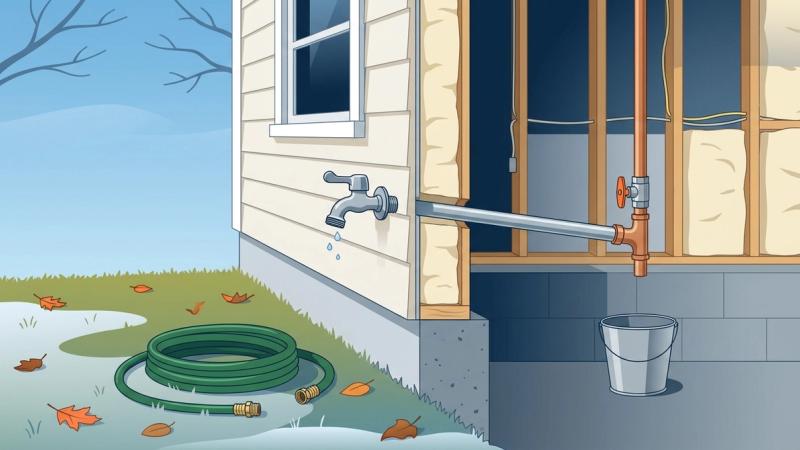
- Standard hose bib: the valve sits at the outside wall, so the pipe holds water right to the exterior. It usually relies on a separate shutoff inside, in the basement or crawlspace.
- Frost-free sillcock: a long stem runs through the wall and closes the valve inside the heated house. Many have a small vacuum breaker cap near the spout.
To check, look in the basement behind the faucet. A long tube passing through the wall means frost-free; a pipe running straight to the wall with a separate valve on it means a standard bib.
How to winterize an outdoor faucet, step by step
Standard hose bib
- Disconnect, drain and store the hose.
- Close the inside shutoff for that faucet fully.
- Open the outdoor faucet and leave it open.
- With a bucket under the inside valve, open its small bleeder cap so the trapped water drains.
- Close the bleeder cap once it stops dripping. Leave the outside faucet open all winter.
This follows the American Red Cross frozen-pipe guidance, which lists outdoor hose bibs among the pipes most at risk of freezing.
Frost-free sillcock
- Remove the hose and any splitter, timer or quick-connect fitting.
- Close the faucet. A short dribble from the spout is normal.
- If there is an inside shutoff, closing it adds protection on an older faucet.
Do frost-free spigots need to be winterized?
Yes, just less. The design only works if the barrel drains each time you shut it off. A hose left attached holds water in the barrel, and one manufacturer's sillcock installation instructions warn that this trapped water can freeze and damage the valve. The damage usually hides until spring, when water runs inside the wall instead of out the spout.
A simple October drain test
- With the hose off, run the faucet at full flow for a few seconds, then shut it off.
- A brief stream that stops means it drains.
- A drip that never stops points to a worn seat washer or stem.
- Have someone run the faucet while you check inside where it enters the house. Damp drywall, drips on the sill plate or a ceiling stain point to a cracked barrel or failed connection.
Leaking inside only when the faucet is on is the classic sign a frost-free sillcock already froze and split. If you find water in a finished wall, close the inside valve and book leak detection and pipe repair before the framing stays wet.
Water won't drain after closing the inside valve
- No bleeder. Some shutoffs have no drain cap, so water stays trapped between the valve and the wall. A valve with a drain port or a frost-free upgrade fixes it.
- The valve doesn't fully close. If the outside faucet keeps running, the inside valve is passing water. Old valves seize, and forcing the handle can snap the stem or start a leak.
- Wrong slope. A frost-free sillcock should pitch slightly down toward the outside. Installed level or tipped back, it holds water all winter and has to be reinstalled.
Repair or frost-free sillcock replacement?
Often repairable: a drip after shutoff (seat washer or stem), water around the handle (packing), or water spitting from the vacuum breaker cap (replaceable on many models).
Replace it when:
- The body or barrel is cracked.
- It is the wrong length or slopes the wrong way.
- Parts for the model are no longer available.
- An old-style bib's inside valve is seized, leaking or buried in a finished basement. A frost-free upgrade ends the yearly drain-down, though the hose still comes off.
Our outdoor faucet repair and replacement service handles sillcocks as well as kitchen and bath fixtures.
When to call a licensed plumber
Call a pro if the inside shutoff is seized or leaking, the connection is soldered inside a finished wall or ceiling, the faucet body is cracked, or the slope needs to be redone. These jobs mean cutting pipe and resealing the wall, so schedule them before cold weather. Veolia, which supplies Cresskill's water, also advises knowing where your shutoff valves are; our October-to-January plan for protecting pipes from freezing covers the rest of the house.
Frequently asked questions
When should I winterize outdoor faucets in Cresskill?
Before the first hard freeze of the season. Doing it in fall leaves time to fix a seized valve or cracked faucet before temperatures drop.
Why is my frost-free hose bib leaking inside the wall?
Usually the barrel froze and split, often because a hose was left attached. It typically leaks only while the faucet is on, and the faucet needs to be replaced.
What is the bleeder valve on an outdoor spigot shutoff for?
It is a small cap on the inside valve that drains the water left between the valve and the outside faucet. Open it with the outdoor faucet open, then close it once the line is empty.
Need Plumbing Service in Cresskill, NJ?
Call Heights Plumbing, Heating & Cooling at (201) 245-7772 or schedule online today!
Schedule Service