In this article
- Is it a main sewer line clog or just one drain?
- What causes main line clogs in older Montclair homes
- What you can safely do right now
- Hydro jetting vs snaking: matching the tool to the clog
- What happens during a jetting visit
- When jetting points to sewer line repair instead
- October timing: check a slow line before the holidays
- Frequently asked questions
A main sewer line clog usually shows up in more than one place at once. A toilet flush gurgles the tub, or the basement floor drain backs up when the washer empties. Hydro jetting is often the right fix for a main line choked with roots, grease or scale, but only after a camera shows the pipe is intact. If the line is cracked, collapsed or sagging, jetting only buys time.
Is it a main sewer line clog or just one drain?
A single slow sink or toilet is usually a local clog. Suspect the main line when you see any of these signs:
- More than one fixture backs up or drains slowly at the same time.
- The basement floor drain gurgles or backs up when the washer drains or a toilet is flushed.
- The lowest drains are hit first, such as a floor drain, basement toilet or laundry tub.
What causes main line clogs in older Montclair homes
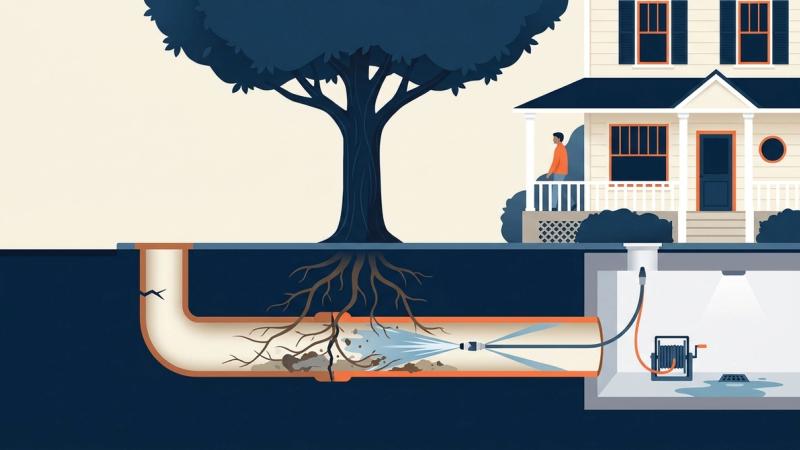
Many homes in Montclair still drain through original clay or cast-iron laterals, often under mature street trees. Common causes:
- Tree roots get into clay joints or cast-iron seams and form a mat that catches debris.
- Grease hardens along the pipe wall.
- Wipes don't break apart the way toilet paper does.
- Scale builds up inside old cast iron and narrows the pipe.
- Sags or low spots let waste settle instead of flowing.
- A broken or collapsed section blocks the flow.
What you can safely do right now
- Stop using water. Every flush or load of laundry ends up at the lowest drain.
- Find the sewer cleanout. It is usually a capped pipe where the main leaves the basement, or outside near the foundation or in the front yard.
- Check the standpipe carefully. On an outdoor cleanout, loosen the cap slowly. Standing water means the blockage is toward the street. A dry pipe points to a clog inside the house.
- Don't open a cleanout that's holding back sewage. If the cap pushes up or seeps, retighten it and call a pro.
- Skip chemical drain cleaners. They rarely clear a main line, and they leave caustic water in the pipe.
A rental snake can get stuck in roots, and it tells you nothing about the pipe's condition.
Hydro jetting vs snaking: matching the tool to the clog
A snake spins a cutting head through the blockage. It works on a single obstruction, like a wad of wipes, and can reopen a line in an emergency. On roots, it cuts a path through the mass and leaves the rest attached to the pipe wall. Those roots keep growing and catching debris, which is why root clogs often return after snaking.
Hydro jetting uses high-pressure water to scour the full diameter of the pipe. It flushes out roots, grease, scale and sludge instead of just punching through them. Hydro jetting a main sewer line is usually the better choice for roots, grease, scaled cast iron and recurring sewer backups. For a single slow fixture, standard drain cleaning is usually enough.
Is hydro jetting safe for old cast-iron, clay or Orangeburg pipe?
It depends on the pipe's condition, not its age. Sound clay or cast iron generally handles jetting well. These pipes can be damaged by jetting:
- Cast iron that is badly scaled or thinned
- Clay with cracked or offset joints
- Deformed Orangeburg, a fiber pipe found in some mid-century homes
That's why a sewer camera inspection should come first.
What happens during a jetting visit
- The technician accesses the line, usually through the cleanout.
- If the line is fully blocked, the technician opens a path so the camera can pass.
- The camera locates the blockage and shows the pipe material, joints and any damage.
- The line is jetted, with extra passes through problem sections.
- A second camera run confirms the pipe is clear to the street connection.
When jetting points to sewer line repair instead
Sometimes a clean pipe reveals the real problem. The camera may show separated joints, a collapsed section, a belly that holds water, or deformed Orangeburg. Jetting can't fix any of those. Depending on what the camera shows, the answer is sewer line repair or replacement or, for a suitable line, trenchless pipe repair.
Who owns the lateral in Montclair, and what permits apply
Under Montclair's sewer code, the property owner is responsible for the building lateral up to and including the connection to the public sewer. Repairs are permitted, licensed work that needs two permits:
- The run from the front property line to the town sewer needs a permit from the Sewer Utility.
- The run from the house to the property line needs a plumbing permit from the construction code office.
If the town's main may be the problem, call the Montclair Water Bureau & Sewer Utility at 973-744-4600, weekdays 8:30 to 4:30.
October timing: check a slow line before the holidays
Heavy fall rain soaks the ground around old laterals. Thanksgiving cooking sends extra grease down the sink, and house guests add showers, flushes and laundry. A line that's slow now can back up on the busiest day of the year. October is a good time for a camera check and, if needed, sewer line cleaning in Montclair.
Frequently asked questions
How often should a main line be jetted if roots keep coming back?
It depends on how fast the roots regrow, which follow-up camera checks will show. Quick regrowth usually means open joints, so a repair or trenchless lining may be a better long-term fix than repeated cleaning.
How do I know if the clog is in the town's sewer instead of mine?
If a camera shows your lateral is clear to the street connection but drains still back up, the town main may be the problem. In that case, report it to the Montclair Sewer Utility.
Need Plumbing Service in Montclair, NJ?
Call Heights Plumbing, Heating & Cooling at (201) 245-7772 or schedule online today!
Schedule Service