In this article
- Whole house repiping signs vs. a single bad section
- How to tell what your pipes are made of
- Galvanized pipe and lead: why it matters
- Got a service line letter from Veolia?
- Repipe vs. repair pipes: how to decide
- PEX or copper, timing and wall openings
- Why fall is a good time to repipe
- Frequently asked questions
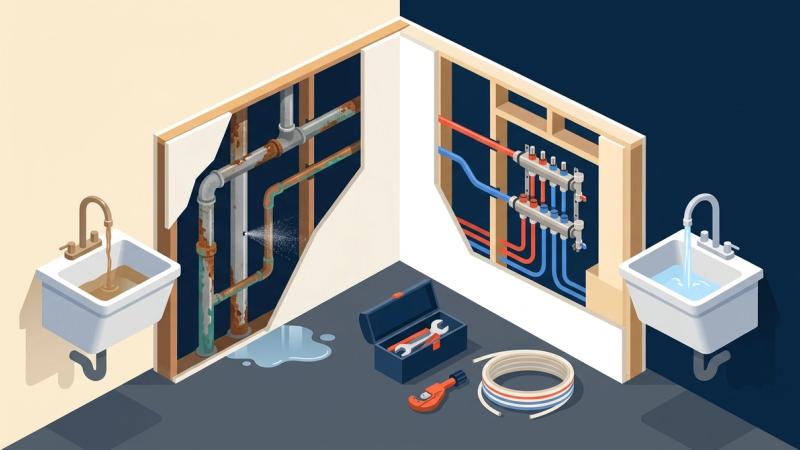
The clearest whole house repiping signs are problems that show up everywhere at once: weak pressure at every tap, rusty water from several fixtures, and leaks that keep turning up in different rooms. If only one faucet or pipe run is acting up, a spot repair usually makes more sense. In older Hillsdale homes, the deciding factor is often what the pipes are made of, and whether galvanized steel or a lead service line is involved.
Whole house repiping signs vs. a single bad section
Signs that point to the whole house
- Low pressure at every fixture, hot and cold, upstairs and down. Galvanized pipe corrodes from the inside, narrowing it throughout the house.
- Leaks in several places over the past few years, not one repeat offender.
- Rusty water from multiple taps, especially on the cold side. Rust only in hot water often points to the water heater instead.
Signs that point to one section
- Low pressure at one faucet or shower, often a clogged aerator, worn cartridge or partly closed shutoff.
- One leak at a fitting, or a pipe damaged by a nail or a freeze.
- Discolored water from one fixture only.
If you can't tell where water is going, professional leak detection pinpoints the source before you commit to a bigger job.
How to tell what your pipes are made of
Go to where the water line enters through the basement wall or floor, usually near the main shutoff and meter. Check the pipe on both sides of the meter if you can see it.
- Magnet test. A refrigerator magnet will stick to galvanized steel. It will not stick to copper or lead.
- Scratch test. Gently scratch the surface with a coin. Copper shows a penny color. Lead is soft, scratches easily and turns shiny silver. Galvanized steel stays dull gray and is hard to scratch.
Then check the pipes along the basement ceiling. Many older Bergen County homes have a mix: original galvanized, copper from earlier repairs, and plastic from a remodel. If you think you've found lead, stop scraping and leave it for your water utility and a licensed plumber.
Galvanized pipe and lead: why it matters
According to the U.S. EPA, lead particles can attach to the surface of galvanized pipes, and over time those particles can enter your drinking water and raise lead levels. That makes galvanized pipe replacement a water-quality decision, not just a pressure one, especially if the home has, or once had, a lead service line feeding that plumbing. A certified lab test will tell you what's in your water today.
Got a service line letter from Veolia?
Hillsdale is served by Veolia North America New Jersey - Hackensack. New Jersey's Lead Service Line Replacement Law, enacted in July 2021, requires community water systems to identify and replace all lead service lines within 10 years, and homeowner notices are part of that effort. Veolia offers a service line material lookup map where you can search your address, plus a survey for reporting what you find with the tests above.
On cost, NJDEP notes that property owners may be responsible for replacing their portion of the service line, and advises contacting your water system before replacing it so the work can be coordinated. That street-to-house pipe is handled as water line replacement, separate from the pipes inside your walls, but it's worth planning both together.
Repipe vs. repair pipes: how to decide
Repair section by section when
- The supply pipes are mostly copper or PEX in good condition and the problem is isolated.
- You've had one leak, not a pattern.
- Pressure and water color are normal everywhere else.
Repipe the whole house when
- Most of the supply plumbing is galvanized steel, common in older homes.
- You've had several leaks in different spots. Each patch leaves the rest of the aging pipe in place.
- Pressure is low throughout the house.
- You're already planning a kitchen or bathroom remodel. With walls open, replacing supply lines now means far less disruption later.
PEX or copper, timing and wall openings
PEX is flexible tubing that snakes through walls and floors with fewer fittings, so it usually needs fewer and smaller openings. It has some give if water freezes, though it isn't freeze-proof. Copper is rigid with a long track record, and its straight runs typically need more access points. Both are sound choices for whole-house repiping; the right one depends on your layout and priorities.
Many single-family repipes take a few days, longer for larger homes or finished basements. Water is typically off while crews work and back on at the end of the day. Expect small, targeted openings at fixtures and along pipe runs, not whole walls removed. Ask up front who handles patching.
Why fall is a good time to repipe
Corroded pipe has thinner walls and weaker joints, and freezing weather adds stress. A fall repipe gets new lines in before the first hard freeze, when failing pipe is most likely to burst. See our guide to protecting pipes during New Jersey cold snaps. Our licensed, background-checked technicians serve homeowners throughout Hillsdale with upfront pricing.
Frequently asked questions
How do I know if my house needs repiping?
Look for problems that affect the whole house: low pressure at every tap, rusty water from several fixtures, or repeated leaks in different places. If your supply pipes are galvanized steel, those signs more likely mean a full repipe.
How long does it take to repipe a house?
A typical single-family home often takes a few days, with larger homes or finished spaces taking longer.
Who pays to replace a lead service line in Hillsdale?
According to NJDEP, property owners may be responsible for the cost of their portion of the service line. Check Veolia's lookup map for your address and contact Veolia before any replacement.
Need Plumbing Service in Hillsdale, NJ?
Call Heights Plumbing, Heating & Cooling at (201) 245-7772 or schedule online today!
Schedule Service