In this article
Most homeowners should flush tankless water heater units about once a year, and sooner if the home gets Fair Lawn's harder well water, the temperature is set high, or the household uses a lot of hot water. A flush, also called descaling, circulates white vinegar through the heat exchanger to dissolve mineral scale before it cuts performance and damages the unit.
How hard is Fair Lawn's water?
It depends on which source reaches your house. Fair Lawn uses its own wells plus purchased water, and the borough's 2022 Water Quality Report lists very different hardness for each:
- Borough wells: 81–396 mg/L (about 5–23 grains per gallon)
- United Water New Jersey (UWNJ): 75–154 mg/L
- Passaic Valley Water Commission (PVWC): 49–168 mg/L
So one Fair Lawn home may get fairly soft water while another gets very hard water. Check the hardness table in the report, or use a home test kit or professional water test for a number specific to your tap.
Why tankless units scale up faster than tanks
A tank heater warms a large volume of water slowly. A tankless unit heats water instantly as it passes through a small, very hot heat exchanger. When hard water heats up, calcium and magnesium come out of solution and stick to those narrow passages. Even a thin layer restricts flow and insulates the metal from the water it's supposed to heat.
Rinnai notes that mineral buildup can erode the unit. Skip maintenance and the unit works harder to deliver the same hot water, efficiency drops, and the heat exchanger takes the damage.
How often to flush a tankless water heater
Manufacturers don't fully agree. Navien recommends descaling at least once a year, and more often with higher mineral content, higher temperature settings or heavier hot water use. Noritz says there's no fixed schedule: about once a year in very hard water, possibly every four to five years in soft water.
Both point to the same rule: frequency follows your water and how you use the unit. For most Fair Lawn homes, yearly is a sensible default. On harder well water, with a high temperature setting or a large household, check sooner. If your water tests soft, you may stretch the interval, but follow your unit's manual.
Signs your unit needs descaling now
- Hot water that swings between hot and cold
- Lower hot water flow at fixtures
- Longer wait for hot water
- New rumbling or popping noises
- Scale error codes, such as "LC" on Rinnai units; Navien and Noritz list their own scale warnings in the manual
Can you descale a tankless water heater yourself?
Yes, but only if the unit has isolation and purge valves (service valves) on the hot and cold lines. Without them, there's no safe way to connect a pump and circulate solution, and many older installations don't have them.
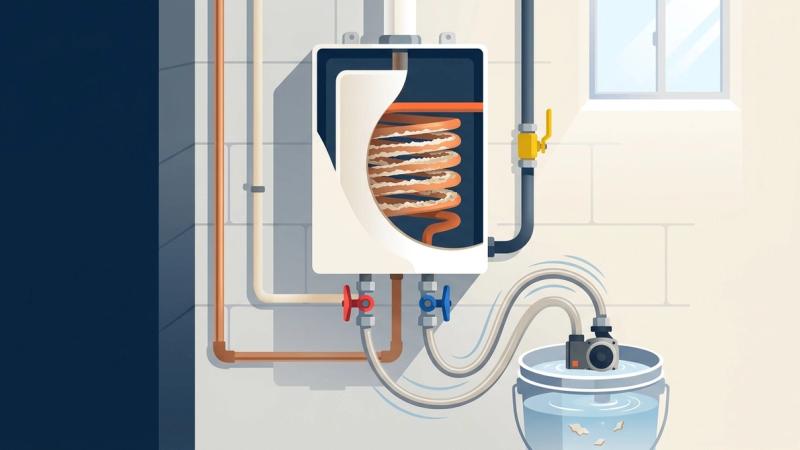
If yours does, Rinnai's official flushing procedure covers the basics:
- Shut off power and gas to the unit.
- Close the three water valves named in the procedure.
- Connect hoses and a small submersible pump to the purge ports.
- Circulate 4 gallons of undiluted white vinegar. Never use chemicals.
- Drain, rinse with fresh water, close the purge valves, reopen the water valves, and restore gas and power.
Noritz describes a 60-minute vinegar flush. Use your own model's instructions for timing and valve order.
Clean the inlet filter too
Most units have a small screen on the cold water inlet. With water off and pressure relieved, remove it, rinse it and reinstall it. A clogged screen causes low flow that can look like scale.
What not to attempt
- Opening the cover or working on internal components
- Disconnecting or adjusting gas lines or the gas valve
- Using chemical descalers
- Cutting into plumbing to add service valves
When to call a licensed pro
- The unit has no service valves and needs them installed
- Error codes or temperature swings return soon after a flush
- A gas unit needs combustion, venting or burner checks. If you ever smell gas, leave the house and call for gas leak detection.
- You want to reduce scale long-term with a water softener or a scale-prevention water filtration system
Our tankless water heater service covers descaling, valve installation, error code diagnosis and repair. If the heat exchanger is badly damaged, we can also discuss replacement, including traditional tank water heaters.
Why October is a good month to flush
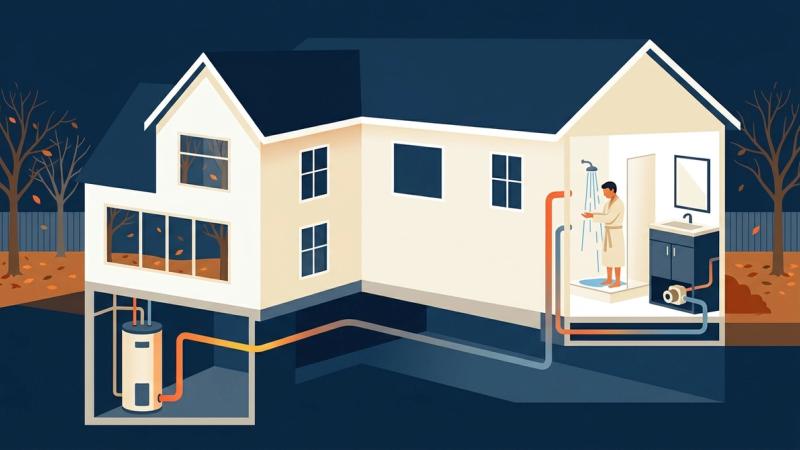
In fall, the water entering your home gets colder, so the unit has to raise it through a bigger temperature jump, and hot water demand climbs through winter. Starting the season with a clean heat exchanger means the unit isn't fighting scale during its hardest-working months.
Frequently asked questions
Is annual tankless maintenance a myth?
Not exactly. Navien recommends at least once a year, while Noritz says it depends on hardness. With some Fair Lawn homes on very hard well water, yearly is a sound default unless testing shows soft water.
Can I flush a tankless water heater with vinegar?
Yes. Rinnai's procedure uses 4 gallons of undiluted white vinegar and says not to use chemicals. You need service valves and a small pump.
Will a water softener stop tankless scale buildup?
A softener removes the calcium and magnesium that form scale, which can reduce how often you need to descale. The unit should still be checked periodically.
Need Plumbing Service in Fair Lawn, NJ?
Call Heights Plumbing, Heating & Cooling at (201) 245-7772 or schedule online today!
Schedule Service