In this article
- What the T&P valve does, and when a drip is normal
- Common causes of a dripping water heater relief valve
- Seeping at the threads is a different problem
- What you can safely check yourself
- Symptom, likely cause and fix
- Never cap or plug the discharge pipe
- When to call a licensed pro right away
- Frequently asked questions
A water heater relief valve dripping now and then usually means the valve is doing its job. It is releasing pressure that built up as the tank heated. A steady trickle, a valve that won't stop running, or water seeping where the valve meets the tank is different. Each of those points to a problem to fix, not live with.
What the T&P valve does, and when a drip is normal
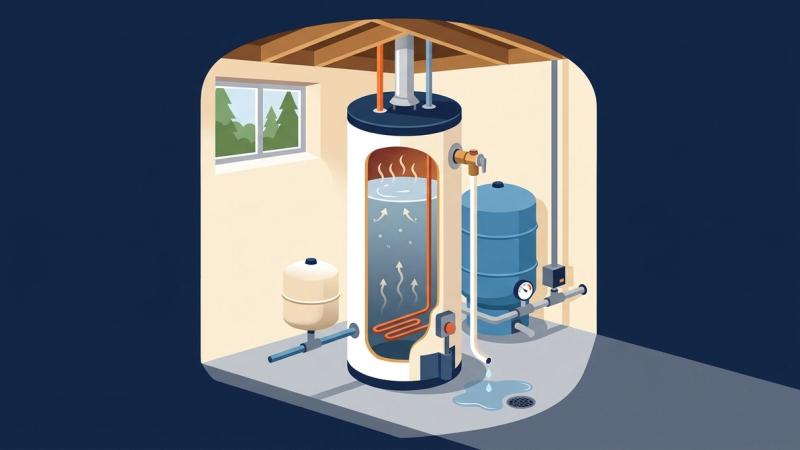
The temperature and pressure (T&P) relief valve is the brass fitting on the top or upper side of a tank water heater, with a pipe running down toward the floor. Under the model plumbing code, it opens at no more than 150 psi or 210°F (ICC International Plumbing Code, Chapter 5). New Jersey's adopted code may differ in its details, but those are the standard ratings. If a thermostat fails or pressure climbs, this valve keeps the tank from becoming dangerous.
An occasional drip after a long heating cycle is common. Constant dripping, or a valve that opens every time the heater runs, means something keeps pushing it past its limit.
Common causes of a dripping water heater relief valve
- Thermal expansion in a closed system. Water expands as it heats. If a check valve, backflow preventer or pressure-reducing valve blocks that extra volume from flowing back out, pressure rises until the valve opens. Manufacturers name this as the usual cause of on-and-off dripping.
- High house water pressure. High incoming pressure leaves little room before one heating cycle pushes past the limit.
- Temperature set too high or a failing thermostat. An overheated tank raises both temperature and pressure.
- Debris or mineral scale. Sediment can lodge in the valve seat and keep it from closing fully.
- A worn valve. Old springs and seals may not reseat properly.
Well homes in Independence
Many homes around Independence, NJ may be on private wells. A well system's pump, pressure tank and check valve keep water from draining back down the well, but that check valve also creates a closed system. Expanding hot water has nowhere to go, so a well home without a thermal expansion tank is a prime candidate for a dripping T&P valve.
Seeping at the threads is a different problem
Check where the valve screws into the tank. According to A.O. Smith's technical bulletin, a leak at the valve threads usually means removing and resealing the valve. Seepage from the tank fitting itself (the spud) can't be repaired, and the heater has to be replaced.
What you can safely check yourself
- Temperature setting. If the dial is near its highest setting, turn it down and see whether the dripping slows.
- Water pressure. A gauge threaded onto a hose bib or laundry faucet shows your static pressure. One with a maximum-reading needle, left on overnight, reveals spikes while the heater runs, a classic sign of thermal expansion.
- Expansion tank. Look for a small tank on the cold line near the heater. If it feels heavy and full, or water comes out of its air valve, it has likely failed.
- Discharge pipe. It should be open and end near the floor or over a drain with a visible air gap. The model code bars a direct drain connection and requires discharge in the same room.
Don't flip the test lever on an old valve. Worn valves often won't reseat, which turns a drip into a steady leak.
Symptom, likely cause and fix
- Drips after heating, then stops: thermal expansion. Fix: add or replace a thermal expansion tank on the cold line.
- Gauge reads high all the time: high supply pressure. Fix: install or repair a pressure-reducing valve and add an expansion tank.
- Water is very hot and the valve discharges: thermostat or control problem. Fix: replace the thermostat or gas control.
- Constant trickle at normal pressure: debris or a worn valve. Fix: replace the T&P valve.
- Seepage at the tank fitting: tank failure. Fix: replace the water heater.
Why a brand-new valve still leaks
If a new valve drips like the old one, it is usually reacting to a pressure or temperature problem that's still there. Sometimes the wrong part went in: a 30 psi boiler relief valve looks similar but opens far below what a water heater needs. Check the rating on the valve tag.
Never cap or plug the discharge pipe
Capping the pipe stops the drip but disables the device that protects the tank from overheating and overpressure. The model code also says the relief valve can't be used to control thermal expansion, so fix the cause instead.
When to call a licensed pro right away
Call immediately if hot water is pouring from the pipe, the valve won't stop running, or there are gallons of water on the floor. State Water Heaters notes that several gallons under an electric heater isn't thermal expansion: shut off the power and get help. Our licensed technicians handle water heater repair and replacement, including expansion tanks and pressure-reducing valves. For hidden water damage, see our leak detection and pipe repair service, and if scale keeps fouling your valves, a water softener may help. October, before heating season, is a good time to look over the heater, valve and expansion tank.
Frequently asked questions
Is a dripping relief valve dangerous?
The drip means the safety device is working, but the pressure or heat causing it should still be fixed. Never plug the pipe.
Why is my water heater relief valve leaking after replacement?
Usually the cause is still there: thermal expansion, high pressure or overheating. Sometimes a 30 psi boiler valve was installed by mistake.
Do I need a thermal expansion tank on a well system?
Often, yes. The well's check valve creates a closed system, so expanding hot water needs somewhere to go.
Need Plumbing Service in Independence, NJ?
Call Heights Plumbing, Heating & Cooling at (201) 245-7772 or schedule online today!
Schedule Service