In this article
- The site visit: sizing, head placement, line set and electrical
- How long does mini split installation take?
- Permits in Fair Lawn
- Outdoor unit placement for North Jersey snow
- Condensate: gravity drain or pump
- Using a mini split for heat this fall and winter
- Startup day: what happens before it runs
- How to prepare for your ductless mini split installation
- Frequently asked questions
A ductless mini split installation runs in five stages: a site visit to size each room and plan routes, the permit, mounting the units, connecting the line set, wiring and drain, and a startup with a pressure test and vacuum before any refrigerant is released. Here is what each step involves in a Fair Lawn home and how to get ready for our ductless mini split installation service.
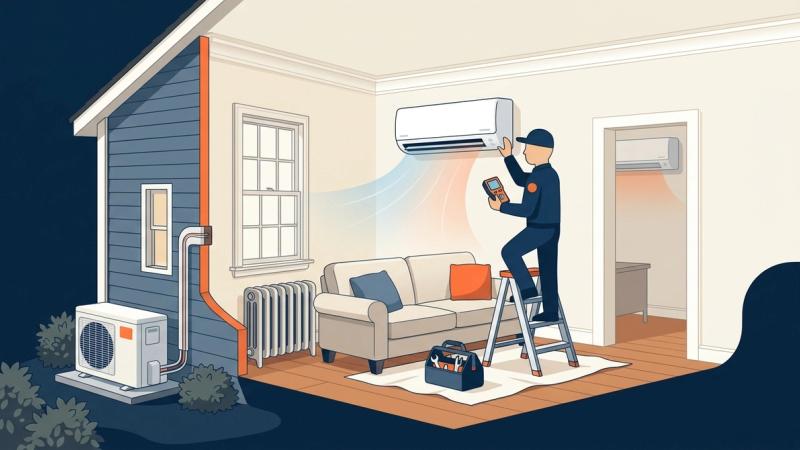
The site visit: sizing, head placement, line set and electrical
The U.S. Department of Energy notes that getting each indoor unit's size and location right is crucial. At the visit we check:
- Room-by-room load (Manual J). Windows, insulation, ceiling height and sun exposure set each head's capacity. An oversized head short-cycles and dehumidifies poorly; an undersized one runs nonstop.
- Head placement. Usually high on a wall with a clear throw across the room. In houses with hot-water baseboard, we plan around the existing radiation and curtains.
- Line set route. Copper lines, control wire and drain run together to the outdoor unit, straight through the wall or through an attic, closet or basement for interior walls.
- Electrical. The outdoor unit needs a dedicated circuit and an outdoor disconnect, so we confirm panel capacity and open breaker spaces.
Still deciding whether ductless fits your house? Our guide to ductless AC for older homes covers that question.
How long does mini split installation take?
A single-zone system with a short line set is often finished in one working day. Multi-zone systems need a line set, drain and wiring for every head, so larger jobs can stretch over multiple days. You'll get a timeline at the site visit. Common slowdowns:
- Coring through brick, stone or block walls
- Long line-set runs through finished rooms or attics
- A full electrical panel that needs work first
- Interior-wall heads that need a condensate pump
Permits in Fair Lawn
A mini split involves mechanical and electrical work. The Fair Lawn Building Department handles construction, electrical and mechanical permits. A licensed contractor normally files the application as part of the job, so ask about it when you review your proposal. The department's construction permit line is (201) 794-5307 for questions about requirements or inspections.
Outdoor unit placement for North Jersey snow
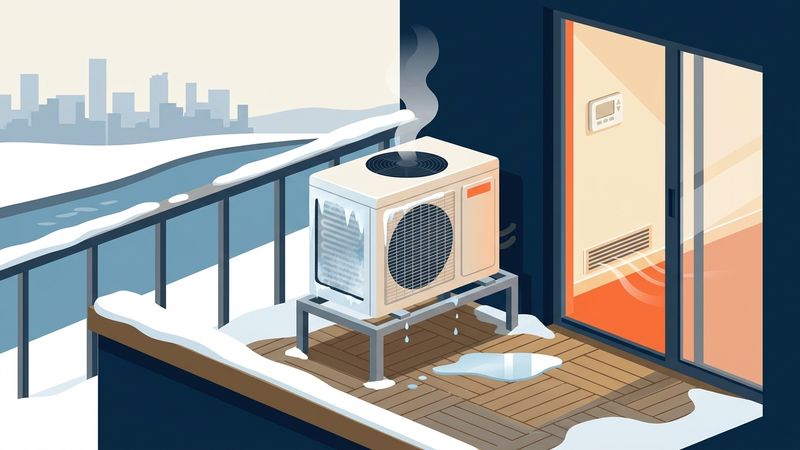
In heat mode, the outdoor unit runs defrost cycles, and that meltwater has to drain away. Good placement:
- Raises the unit above typical snow depth so the coil breathes and defrost water doesn't refreeze around the base.
- Avoids roof edges without gutters, where ice and runoff drop onto the unit.
- Keeps defrost water off walkways and driveways.
- Leaves service clearance and stays within line-set limits.
Wall bracket or ground stand?
A wall bracket keeps the unit well above drifts but needs a solid wall and vibration isolation, so we avoid bedroom walls when possible. A raised ground stand is easier to service and keeps vibration off the house, but must be tall enough and clear of the roof drip line.
Condensate: gravity drain or pump
In cooling mode, the heads pull water from the air. On an exterior wall, a gravity drain runs downhill outside; it is silent and only needs to stay clear. Where gravity won't work, a condensate pump lifts the water. Pumps hum briefly, need occasional cleaning, and a failed pump can make the head leak, so we mount them where they can be reached.
Using a mini split for heat this fall and winter
Heat pump mini splits heat as well as cool. ENERGY STAR explains that the outdoor unit pulls heat from outdoor air even when it's cold, and that certified models use up to 60% less energy than standard electric radiators. An October install lets you heat with the mini split on chilly shoulder-season days instead of firing the boiler. Standard models lose capacity as temperatures drop, while cold-climate models are designed to keep producing heat in deeper cold, so ask about low-temperature heating capacity if a head must carry a room through January.
Startup day: what happens before it runs
- Pressure test. The lines are pressurized with nitrogen and watched for drops that point to a leak.
- Vacuum. A vacuum pump pulls air and moisture out, confirmed with a micron gauge.
- Charge check. The factory charge is released, refrigerant is added for longer line sets per manufacturer specs, and readings are verified.
- Function test. Cooling, heating and drain flow are checked at every head.
- Walkthrough. We show you the remote's modes and how to wash the filters. Ongoing HVAC maintenance keeps coils and drains clean.
How to prepare for your ductless mini split installation
What you can do
- Clear furniture and decor from each head location and a path to it.
- Open access to the attic, closets or basement along the route.
- Look for open breaker spaces, but leave the panel cover on.
- Clear plants and clutter from the outdoor unit spot.
- Check current PSE&G and NJ Clean Energy rebate programs before you buy; details change.
What stays with a licensed pro
Refrigerant handling and line-voltage wiring are not DIY jobs. A poor flare or skipped vacuum leads to leaks and early failure, and wiring mistakes are a safety risk. Our background-checked, licensed technicians handle both.
Frequently asked questions
Should I choose a single-zone or multi-zone mini split?
Single-zone pairs one head with one outdoor unit and suits a single room or addition. Multi-zone runs several heads from one outdoor unit, with fewer units outside but a longer install.
What are the mini split electrical requirements?
The outdoor unit needs a dedicated circuit sized to the equipment and a disconnect near the unit. Indoor heads are typically powered through the connecting wire from the outdoor unit.
Does a mini split installation need a permit in Fair Lawn?
The work involves mechanical and electrical permits through the borough Building Department. Your installer typically files them.
Need Air Conditioning Service in Fair Lawn, NJ?
Call Heights Plumbing, Heating & Cooling at (201) 245-7772 or schedule online today!
Schedule Service