In this article
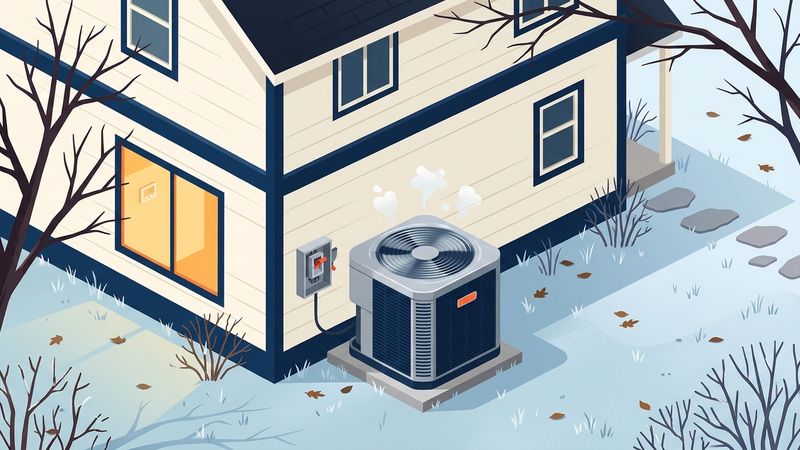
An outside AC unit running in winter isn't always a problem. First confirm it's actually an air conditioner. Many North Jersey homes have a heat pump outside, and a heat pump is supposed to run in November when the heat is on. A cooling-only AC should sit silent once cooling season ends. If yours keeps running, the usual causes are a stuck contactor, a thermostat or wiring fault, or a thermostat set to the wrong system type.
Step 1: Heat pump or air conditioner?
From the yard, a heat pump and a central AC look almost identical. Three checks usually settle it.
Read the label
Find the rating plate or energy label on the outdoor unit, or check your installation paperwork. Carrier explains that a label listing both a SEER2 cooling rating and an HSPF2 heating rating means the unit is a heat pump. An air conditioner shows only cooling ratings.
Look for a reversing valve
Without removing any panels, look through the grille at the piping near the compressor. According to Trane's identification guide, a brass valve with three fittings on one side is a heat pump reversing valve. Cooling-only units don't have one.
Run a heat-mode test
Set the thermostat to heat a few degrees above room temperature and go outside. If the outdoor unit kicks on, Trane notes, it's a heat pump. But if the label says cooling-only and the unit still starts in heat mode, the thermostat is likely set up wrong (more below).
What about dual-fuel systems?
Some homes pair a heat pump with a gas furnace, using the heat pump in milder weather and the furnace when it gets colder. An outdoor unit that runs on some November days and not others can be perfectly normal. Heat pumps also run defrost cycles, and you may see steam rising off the cabinet. That's expected.
Step 2: Why a cooling-only AC won't turn off
If you've confirmed it's AC-only, it shouldn't be running in the cold at all. The likely causes:
- Stuck or welded contactor. The contactor is the switch inside the outdoor unit that powers the compressor and fan when the thermostat calls for cooling. Its contacts can stick or weld closed, leaving the condenser running with the thermostat off. A telltale sign is the outdoor unit humming while the indoor blower is off.
- Thermostat or wiring fault. A failing thermostat, or a shorted low-voltage wire between the thermostat, furnace and condenser, can keep sending a cooling signal. Wire run along an outside wall can get nicked, crushed or chewed.
- Wrong system type on the thermostat. A thermostat configured for a heat pump but wired to an AC and furnace can start the outdoor unit on a call for heat. This often shows up after a new thermostat install or a settings reset.
Is an AC running in cold weather causing damage?
A cooling-only unit isn't designed to run in cold weather, so every hour it runs now is wear on the compressor under conditions it wasn't built for. If the indoor blower is also moving air across a chilled coil, the evaporator coil can frost or ice over. And you're paying to cool a house you're also paying to heat. Shut it down today rather than waiting.
Step 3: Shut it down safely
- Set the thermostat to OFF. Wait a few minutes. If the outdoor unit stops, the thermostat or its settings are the likely culprit.
- If it keeps running, cut power at the disconnect. That's the box on the wall near the condenser. Pull the handle or flip the switch, or turn off the AC breaker at your main panel.
- Don't open the unit or touch the contactor. It carries line voltage, and pressing or prying on it is a real shock risk.
- If it turned out to be a heat pump, don't cut its power to stop it. That's your heat. Call for service instead.
Step 4: What the repair involves
A technician first confirms whether the thermostat is actually calling for cooling, which separates a control problem from an outdoor unit problem. From there:
- Contactor: with power off, the stuck contactor is replaced with a matching part.
- Thermostat: the system-type setting is corrected, or a failed thermostat is replaced.
- Wiring: the low-voltage circuit is traced, the short found and the damaged run repaired.
When it points to bigger condenser problems
A contactor doesn't usually stick for no reason. Age, insects, debris or a component drawing too much current can burn the contacts. A good tech checks the capacitor, fan motor and compressor before calling the job done, especially if the unit ran for a while in the cold. If the condenser is older and showing several problems, our AC condenser repair and installation team can lay out repair versus replacement with upfront pricing. For simpler fixes and seasonal checkups, see our air conditioning repair and maintenance services. We handle this regularly for homeowners in Dumont and across Bergen County.
Frequently asked questions
Is it normal for my outdoor unit to run in November with the heat on?
Yes, if it's a heat pump, since that's how it heats your home. If it's a cooling-only air conditioner, no. Shut it down and have it checked.
Why does my outdoor unit run when the heat is on but the furnace stays off?
On an AC-and-furnace system, that usually means the thermostat is set to the heat pump system type, so a heat call starts the condenser. A technician can correct the configuration and confirm the wiring.
Should I leave the breaker off all winter?
For a cooling-only AC with this fault, leaving the disconnect or breaker off until it's repaired is reasonable. Just don't switch it back on in spring before the problem is fixed. Our guide on AC covers and breakers in winter has more on off-season care.
Need Air Conditioning Service in Dumont, NJ?
Call Heights Plumbing, Heating & Cooling at (201) 245-7772 or schedule online today!
Schedule Service