In this article
If you are deciding on R22 AC repair or replace this fall, the short answer is this: a sound R-22 system with no leaks can keep running legally, but a system that needed refrigerant this summer is usually a candidate for leak repair at minimum and often for replacement. October gives you time to make that call calmly, before the next heat wave forces it. This guide walks through the options for Fair Lawn homeowners. If you want background on the phaseout itself, see our R-22 phaseout guide for Hillsdale homeowners.
Is it still legal to run and service an R-22 system?
Yes. According to the EPA's homeowner FAQ, there is no requirement to replace an R-22 system or convert it to a different refrigerant. What changed is supply: since 2020, only recycled, reclaimed or previously produced R-22 can be used to service existing equipment. That limited supply is why R-22 service is expensive, and why a system that keeps losing refrigerant gets more costly every time it is recharged.
First, confirm your system actually uses R-22
You can check this yourself in a few minutes:
- Read the data plate on the outdoor condenser. It lists the refrigerant type, often as R-22 or HCFC-22.
- Check the install date. Systems installed before about 2010 are the likely R-22 candidates.
- Look at your paperwork. Old invoices or the original installation records may list the refrigerant.
If the plate is faded or missing, a technician can identify it during a visit.
R22 AC repair or replace: your realistic options
1. Find and fix the leak, then recharge
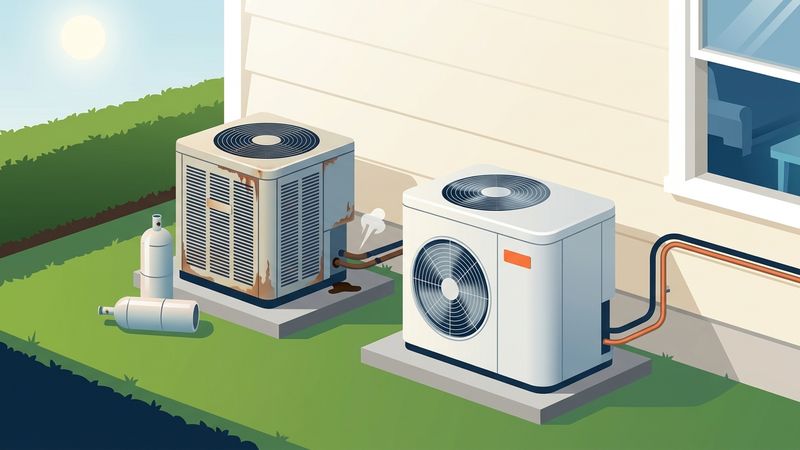
Refrigerant does not get used up. If your system ran low this summer, it has a leak. The EPA advises homeowners to ask technicians to locate and repair leaks rather than simply topping off a leaking system. Topping off buys a few weeks or months and sends scarce, costly R-22 out into the air. Professional refrigerant leak repair makes sense when the leak is in an accessible spot, such as a valve or fitting, and the rest of the system is in good shape.
2. Retrofit to a substitute refrigerant
Some substitutes, such as MO99 or RS-44b, are used to convert R-22 systems. A retrofit is not just swapping one gas for another. The EPA says a technician should recover the R-22 (venting it is illegal), follow the equipment manufacturer's guidelines and explain how the conversion may affect your system's performance and energy use. A retrofit can make sense for a newer R-22 unit in good condition. It makes less sense for an aging system with a recurring leak, because the leak still has to be fixed first.
3. Replace the system
Replacement usually wins when the system has leaked more than once, the leak is in the evaporator coil or the outdoor coil, the compressor is struggling, or the equipment is well past its expected life. Our R-22 replacement and R-454B installation service covers the full changeout.
Avoid cheap "R-22a"
You may see R-22a sold online as a low-cost R-22 replacement. The EPA warns that it has been falsely marketed as R-22 or an R-22 substitute and is not acceptable for these systems. It is a flammable product and carries a fire risk in equipment never designed for it.
If you replace: R-454B vs. R-410A, coils and line sets
Most new residential equipment is now designed for R-454B. Under the EPA's May 2026 rule, R-410A residential systems manufactured before 2025 can still be installed, so you may be quoted either refrigerant. Ask your contractor which one a quote uses and why.
A few points matter for older Fair Lawn homes:
- The indoor coil should match the new outdoor unit. An R-22 evaporator coil was not built for R-454B or R-410A, so a proper replacement includes a matched coil.
- Refrigerants are not interchangeable. Carrier notes that R-454B cannot be put into an R-410A system, so the whole system has to be designed for one refrigerant.
- Line sets depend on the situation. Whether existing copper lines can be reused depends on their size, condition and the new equipment manufacturer's requirements. A technician should inspect them rather than assume.
- The condenser pad and electrical may need updating to fit a new outdoor condenser.
Why October is the right time to decide
After the cooling season, nothing is urgent. You can get the system evaluated, compare repair, retrofit and replacement quotes, and schedule work on your timeline instead of during a July breakdown. Homeowners across Fair Lawn also find it easier to plan around a fall installation than an emergency one.
What you can safely check yourself
- The data plate and install date
- Ice on the refrigerant lines or indoor coil earlier this summer
- Oily residue on fittings near the outdoor unit
- Rising run times or weaker cooling over recent summers
- How many times the system has been recharged
What needs a Section 608-certified technician
Anything that involves handling refrigerant: leak detection, recovery, recharging, retrofits and replacements. The EPA recommends hiring certified technicians for this work. Do not open refrigerant lines or add refrigerant yourself.
Frequently asked questions
Can I still recharge R-22?
Yes, using recycled, reclaimed or previously produced R-22. The EPA recommends repairing the leak first rather than repeatedly topping off the system.
Do I have to replace my R-22 system?
No. The EPA does not require homeowners to replace or convert working R-22 equipment. The decision comes down to the system's condition and repair history.
Can I put R-454B into my old R-22 system?
No. A system has to be designed for its refrigerant, and moving to R-454B means installing equipment built for it, including a matched indoor coil.
Is R-22a a safe substitute?
No. The EPA says R-22a has been falsely marketed as an R-22 replacement and carries a fire risk.
Need Air Conditioning Service in Fair Lawn, NJ?
Call Heights Plumbing, Heating & Cooling at (201) 245-7772 or schedule online today!
Schedule Service