In this article
- What a MERV rating actually measures
- Choosing the best MERV rating for your home by goal
- Will a higher MERV filter hurt my furnace?
- Why a 4-inch media filter cabinet beats a 1-inch filter
- Whole-house filtration vs. a portable air purifier
- How often to change your furnace filter in winter
- What you can check yourself, and when to call a pro
- Frequently asked questions
For most households, the best MERV rating for home use is MERV 13, provided your furnace fan and filter slot can handle it and you change the filter on schedule. MERV 8 covers basic dust, MERV 11 suits allergies and pets, and MERV 16 rarely fits a home system. Filter thickness and fit matter just as much as the number.
What a MERV rating actually measures
MERV (Minimum Efficiency Reporting Value) rates how well a filter captures particles of different sizes in a standardized test. Higher numbers catch smaller particles. Per the EPA's guide to air cleaners in the home, filters rated MERV 13 and above must remove at least 50% of the smallest test particles.
- MERV 8: Household dust, lint, most pollen and mold spores.
- MERV 11: Adds finer dust and much of the pet dander in the air.
- MERV 13: Adds a meaningful share of smoke-sized fine particles.
- MERV 16: The highest capture on the scale, but most home systems aren't designed to move air through it.
Choosing the best MERV rating for your home by goal
- Basic protection: MERV 8 keeps dust off the blower and coil. It's a reasonable floor, not a target.
- Allergies: A furnace filter for allergies should be MERV 11 or 13. October is hard on allergy sufferers: windows close, the heat comes on and fall pollen and mold spores recirculate through the house.
- Pets: MERV 11 at minimum, checked more often, since hair and dander load filters quickly.
- Smoke and fine particles: The EPA recommends at least MERV 13, or as high as your fan and filter slot can handle. Add a portable HEPA purifier in bedrooms during smoke events.
Will a higher MERV filter hurt my furnace?
Usually not, if it's changed often. The EPA says most systems can take MERV 13 without problems, but because systems are rarely labeled for it, it advises asking an HVAC professional. We cover the airflow side in detail in our post on whether your system can handle a MERV 13 filter.
Why a 4-inch media filter cabinet beats a 1-inch filter
A 1-inch MERV 13 and a 4- or 5-inch MERV 13 share a rating, not performance. The thicker filter has far more pleated surface area, so air moves through it with less resistance, and it holds more dirt before clogging. Thin filters also tend to sit loosely in slots cut into the duct, letting air slip around the edges unfiltered. A dedicated cabinet seals that path.
What a cabinet upgrade involves
- A technician measures the return duct and the space beside the furnace.
- A section of duct is removed and the cabinet is fitted in its place, with a gasketed access door.
- Joints are sealed so air can't bypass the filter.
- Airflow is checked to confirm the system still moves enough air.
An undersized or leaky return may need ductwork repair and installation first.
Whole-house filtration vs. a portable air purifier
Whole-house air filtration cleans all the air your system moves, but only while the blower runs, so it suits forced-air homes with dust or allergy concerns throughout. A portable purifier cleans one room, making it the better pick for a bedroom, a sick family member, a smoke event, or older Ridgewood homes heated by radiators with no ductwork.
On MERV 13 vs HEPA: HEPA captures more of the smallest particles but is too restrictive for a typical home furnace without dedicated equipment. MERV 13 is the practical whole-house choice; HEPA belongs in portable units.
How often to change your furnace filter in winter
ENERGY STAR advises checking your filter monthly, especially in winter and summer, and changing it at least every three months. A dirty filter slows airflow, wastes energy and lets dust build up in the system. Once the heat comes on in October, the blower runs more and the filter loads faster. High-MERV filters need closer watching because they trap more and restrict airflow more as they fill.
What you can check yourself, and when to call a pro
Safe homeowner checks
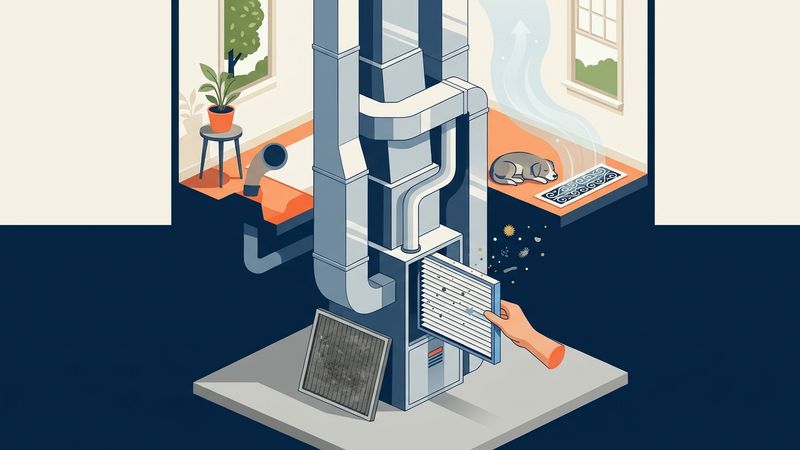
- The size printed on the frame matches the slot.
- The airflow arrow points toward the furnace.
- There are no gaps around the edges, and the slot cover is closed.
- After a month, the filter isn't caked or dark.
When you need a licensed technician
- Choosing the right rating for your specific system.
- Installing a media cabinet or whole-home filtration.
- Airflow and static pressure testing, reviewed by our engineers on staff.
- Older blower motors, whistling at the filter, or uneven heating after a filter change.
Our background-checked, licensed technicians install air cleaners, purifiers and filtration for homeowners in Ridgewood, NJ and across Bergen County.
Frequently asked questions
Do FPR and MPR ratings mean the same thing as MERV?
No. The EPA notes that MERV is a national consensus standard, while FPR (Home Depot) and MPR (3M) are proprietary scales. There's no exact conversion, so compare MERV numbers when they're listed.
Is a 1-inch MERV 13 the same as a 4-inch media filter?
Same rating, different performance. The thicker filter restricts airflow less and lasts longer between changes.
Is MERV 13 as good as HEPA?
HEPA captures more fine particles, but it isn't practical in most home furnaces. Use MERV 13 for the whole house and portable HEPA units in individual rooms.
Need Indoor Air Quality Service in Ridgewood, NJ?
Call Heights Plumbing, Heating & Cooling at (201) 245-7772 or schedule online today!
Schedule Service