In this article
The most common leaky ductwork signs show up within weeks of turning the heat on: rooms that never get comfortable, a house that gets dusty faster, gas bills that climb more than the weather explains, and a hiss from the ducts while the blower runs. If the furnace runs and blows warm air near the unit but the far rooms stay cool, suspect the ducts. Here's how a Phillipsburg homeowner can check an unfinished basement or attic and decide whether sealing is enough.
Leaky ductwork signs vs. a furnace problem
A furnace problem usually affects the whole house. A duct problem usually affects some rooms more than others.
- Likely the furnace: no heat anywhere, lukewarm air at every register, the system shutting off after a few minutes, or error codes on the control board.
- Likely the ducts: strong, warm airflow near the furnace but weak or cool air at the end of a run, rooms that lag behind the rest of the house, or noise from duct seams rather than the furnace cabinet.
Energy Star lists high bills, rooms that are hard to heat, stuffy rooms, ducts in attics or crawlspaces, and kinked flex duct as signs of poorly performing ducts.
Why one room is colder than the rest of the house
A cold room is usually at the end of a long run, over a garage, or fed by a duct that passes through an unheated space. If a joint along that run has pulled apart, or a flex duct is crushed or kinked, the room gets only what's left. A fully disconnected duct can leave a register with almost no airflow while the basement or attic quietly gets the heat.
Why the house is dustier once the heat is on
Return ducts carry air back to the furnace. Leaks on that side pull in air from the basement, attic or wall cavities, along with dust and insulation fibers that bypass your filter. A loose filter door or gaps around the filter slot do the same. If dust jumped after the November startup, check the return side first. A better filter can't catch air that sneaks around it; our guide to the best MERV rating for a home in heating season covers the filter side.
How to check exposed ducts yourself
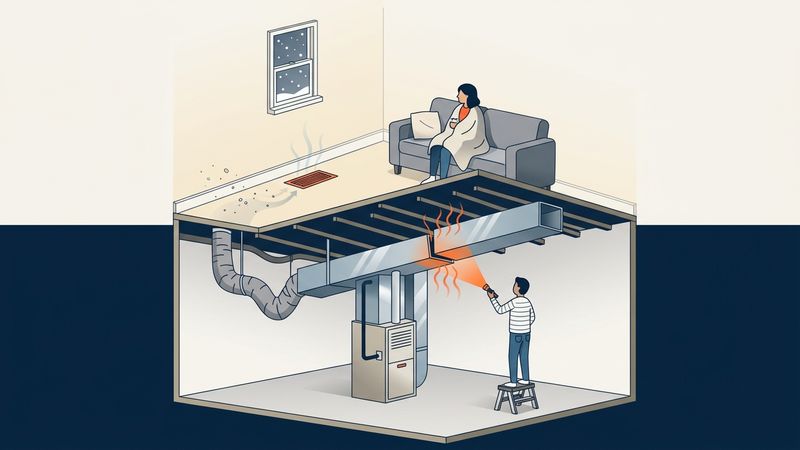
With the heat running, take a flashlight to the unfinished basement or attic. Stay clear of wiring and don't open the furnace cabinet.
- Look at the joints. Check seams, elbows, takeoffs from the main trunk and where branches meet the boots. Look for gaps, separated sections, dangling flex duct and dust streaks around seams, which often mark a leak.
- Feel and listen. Run your hand along joints for escaping air and listen for hissing.
- Use incense for small leaks. Hold a lit stick near a seam. Smoke blowing away means a supply leak; smoke pulled in means a return leak. Keep it well away from the furnace, water heater and anything flammable.
- Check register edges. Energy Star names register connections as common leak spots. Remove a cover and look for gaps between the boot and the floor or ceiling.
- Check the filter slot. A missing cover or loose filter lets the furnace draw unfiltered basement air.
Is leakage into a basement really lost heat?
Partly. Some of it warms the basement, but it isn't reaching the rooms you're trying to heat, so the furnace runs longer to satisfy the thermostat. Return leaks in a basement also pull in dust and moisture, and near a gas furnace or water heater they can affect how those appliances vent.
Can you seal ducts yourself? Mastic vs. foil tape
Yes, on ducts you can reach. Energy Star recommends mastic sealant or metal (foil) tape and says to never use duct tape.
- Mastic: a paste brushed over seams. Best for irregular joints, elbows and boots.
- Foil tape: works well on straight, clean seams. Wipe the duct clean first so it bonds.
Energy Star also suggests insulating ducts you can reach in unconditioned spaces like attics.
Seal, repair or replace: what decides it
Sealing is usually enough when
- The ducts are solid metal in good shape, with leaks at seams and joints.
- Rooms get some airflow, just less than they should.
Repair is needed when
- A section is disconnected, crushed or badly kinked.
- Flex duct is sagging, torn or longer than the run needs.
- Boots have pulled away from the floor.
Replacement or re-running makes sense when
- The ducts are old, corroded or patched many times over.
- The layout never worked: undersized runs, too few returns, or an addition without proper ductwork.
- Leaks are widespread, including inside walls and ceilings.
When to call a licensed pro
Bring in a professional for ducts you can't reach, many leaks across the system, or any return-side leak near a gas furnace or water heater. Energy Star's duct sealing fact sheet notes that sealing can reduce back-drafting, where combustion gases are pulled into the home instead of venting outside. That makes these leaks a safety issue, not just a comfort one. Our background-checked, licensed technicians, backed by engineers on staff, handle ductwork repair, sealing and replacement for homes in Phillipsburg, NJ and across Warren County, with upfront pricing before work begins.
Frequently asked questions
Is duct sealing worth it?
When leaks are why rooms are cold or dust is up, sealing reachable ducts is one of the most direct fixes. It won't fix crushed, disconnected or poorly laid-out ducts, which need repair or redesign.
Can I use duct tape on ducts?
No. Energy Star says never to use duct tape; use mastic or metal foil tape instead.
Will a better filter fix the dust?
Only if air actually passes through it. Seal return leaks and the filter slot first, then look at whole-home air cleaners and filtration.
Need Indoor Air Quality Service in Phillipsburg, NJ?
Call Heights Plumbing, Heating & Cooling at (201) 245-7772 or schedule online today!
Schedule Service