In this article
- Signs you need repiping, not just another repair
- How to tell what your pipes are made of
- What causes pinhole leaks and rusty water
- Service line or the pipes inside?
- What repiping involves: PEX vs. copper
- Why October is a good time to look
- What to check yourself, and when to call a pro
- Frequently asked questions
The clearest signs you need repiping are problems that show up across the whole house, not in one spot: leaks that keep returning in different places, low water pressure at every fixture, and rusty or discolored water from more than one tap. One leak under one sink is a repair. A pattern means the system is wearing out. In an older Fair Lawn home, the age of the house and a few minutes in the basement tell you a lot about which situation you're in.
Signs you need repiping, not just another repair
Ask whether the problem is local or everywhere. These point to the whole system:
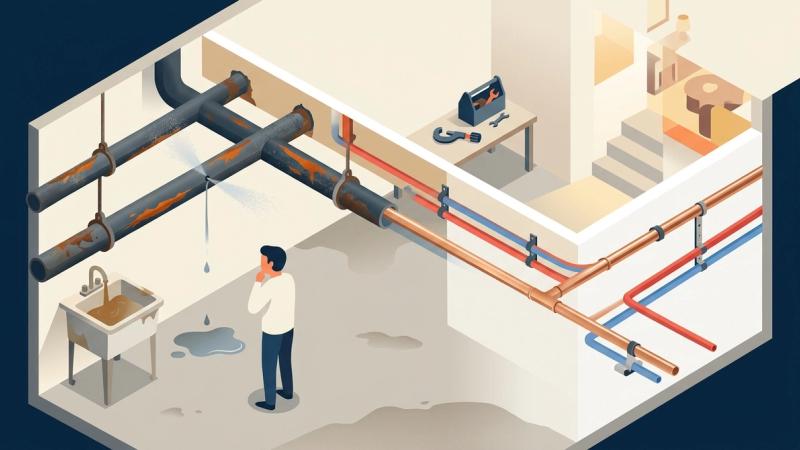
- Leaks that move. A fixed joint holds, then a new pinhole appears elsewhere.
- Low water pressure across the whole house. If every faucet and shower is weak, corrosion may be narrowing the pipes. Weak flow at one faucet is more often a clogged aerator or bad valve.
- Rusty or discolored water at several taps. Brown water only on the hot side can point to the water heater; discoloration from cold taps throughout the house points to the pipes.
- Visible corrosion on exposed pipe: green or white crust at copper joints, or rust weeping from galvanized fittings.
How to tell what your pipes are made of
Go to the basement or crawlspace where pipes are exposed, ideally near the water meter and water heater.
- Try a magnet. If a strong fridge magnet sticks, it's galvanized steel.
- Scratch gently with a coin or key away from joints. Copper shows a penny color. Galvanized shows dull silver-gray. Lead is soft, scratches easily to bright silver, and a magnet won't stick.
- Look for plastic. Flexible red, blue or white tubing is usually PEX; rigid cream or tan pipe is usually CPVC.
Wash your hands if you touched possible lead, and don't scrape hard or cut into anything.
Reading your pipes by the age of the house
Galvanized steel was common in homes built before the 1960s. That describes a lot of Fair Lawn: Radburn began in 1928, and many neighborhoods filled in after World War II. Partial updates are common, so you may find copper near the water heater and old galvanized running upstairs. Check every exposed section.
What causes pinhole leaks and rusty water
Pinhole leaks in copper
Pinholes usually come from water chemistry, pressure and age slowly thinning the pipe wall from inside. Clamps and epoxy stop a drip, but as Repipe.com points out, they don't fix the cause, so new pinholes keep appearing. For local context, the Borough's 2022 water quality report shows Fair Lawn's water is a blend: roughly 55% from 16 borough wells in the New Brunswick Aquifer, about 35% from Passaic Valley Water Commission and about 10% from Veolia. That doesn't diagnose any one home's pipes.
Galvanized pipe and water quality
Galvanized pipe rusts inward, causing both low pressure and brown water. The EPA notes that lead particles can attach to galvanized pipe and get into drinking water over time.
Service line or the pipes inside?
The service line runs from the street to your house; interior pipes start after the meter. New Jersey's July 2021 Lead Service Line Replacement Law requires water systems to find and replace lead service lines within 10 years, and the NJ DEP notices page explains that replacement can cover lead or galvanized lines, with owners possibly paying for their portion. Replacing the service line doesn't touch the pipes inside your walls. For the exterior line, see our water line repair and installation service; our Hackensack post on street line vs. inside pipes covers the difference in detail.
What repiping involves: PEX vs. copper
Whole-house repiping replaces supply lines from the meter to each fixture. New pipe is run, connected and pressure-tested, then old lines are taken out of service.
- PEX is flexible, needs fewer fittings, and can often be fished through walls with fewer openings. It tolerates freezing better than rigid pipe, though it can still freeze.
- Copper is rigid and durable with a long track record, but needs more joints and often more wall access.
Scope and disruption depend on the number of bathrooms and floors, finished walls or ceilings, how accessible the runs are, and whether the service line is handled at the same time.
Why October is a good time to look
Before the heat comes on and the first freeze arrives, exposed basement and crawlspace pipes are easy to inspect, and corroded or thin pipe is most likely to fail in a cold snap. Note weak spots now and review our tips on protecting pipes from freezing in New Jersey cold snaps.
What to check yourself, and when to call a pro
Safe to do: magnet and light scratch tests, comparing pressure at several fixtures, running cold taps to check color, and looking for crust, rust or damp spots.
Call a licensed plumber if you find or suspect lead, see active leaks or ceiling stains, or have repeat pinholes. Don't cut, unscrew or heat old pipes yourself.
Frequently asked questions
When should I repipe a house instead of repairing it?
When leaks keep returning in new places, pressure is low throughout, or rusty water shows at multiple taps. Those point to the whole system rather than one bad section.
Do all older Fair Lawn homes have galvanized pipes?
No. Many pre-1960s homes were built with galvanized steel, but plenty have been updated. A magnet test on each exposed section tells you.
Is PEX or copper better for repiping an older home?
Both work well. PEX usually means fewer wall openings; copper is rigid with a long history. Layout and access often decide it.
Need Plumbing Service in Fair Lawn, NJ?
Call Heights Plumbing, Heating & Cooling at (201) 245-7772 or schedule online today!
Schedule Service