In this article
The best time for AC condenser maintenance is right after the cooling season ends, not the week before the first heat wave. In October, last summer's performance is still fresh in your mind. You can clean the coils and clear space around the unit yourself, then have a licensed technician fix whatever struggled long before the June rush.
What last summer's performance says about your condenser
How the system behaved on the hottest afternoons is the best clue to what needs attention now.
- It ran nonstop. Common causes are dirty condenser coils, low refrigerant, or a compressor losing efficiency. Dirty coils are the easiest to rule out first.
- It couldn't hold the setpoint on hot afternoons. If the house crept up a few degrees every afternoon, the condenser may not be shedding heat well. That can mean blocked coils, restricted airflow around the unit, a weakening capacitor, or a refrigerant problem.
- The fan was noisy. Grinding, squealing or rattling usually points to worn fan motor bearings, a loose blade, or debris inside the cabinet. A unit that hummed while the fan didn't spin often has a failing capacitor.
- The copper lines iced up. Ice on the refrigerant lines usually means low refrigerant or poor indoor airflow, such as a clogged filter or dirty evaporator coil. Call a pro rather than chipping it away.
Write down what you noticed. Specific symptoms help a technician diagnose faster.
End-of-season AC condenser maintenance you can do yourself
1. Shut off the power
Turn the system off at the thermostat, then switch off power at the outdoor disconnect box or the breaker. Bryant's coil cleaning guide says to always do this before any coil maintenance.
2. Clear debris and check clearance
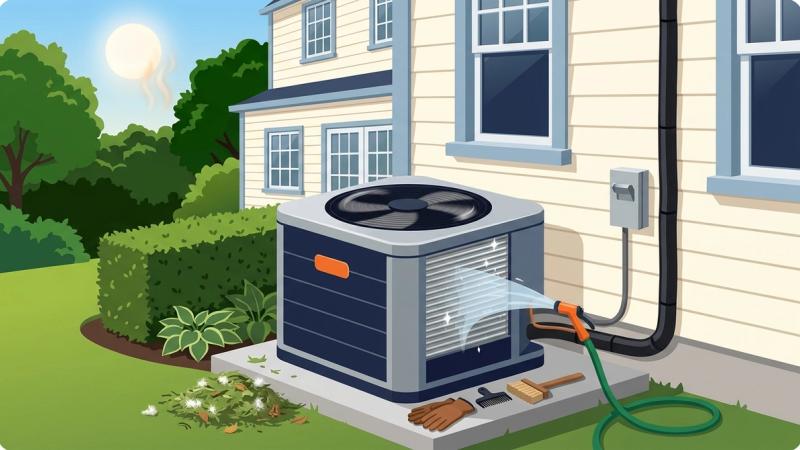
Pull leaves, grass clippings and twigs off the top grille and away from the base. In Hillsdale yards, the usual culprits are foundation shrubs that grew in over the summer, fences or lattice built too close, and fall leaves piled against the coil. Required clearance depends on your unit, so check the label on the cabinet or the installation manual rather than guessing.
3. Rinse the coils gently
Use a garden hose on a gentle stream and rinse straight through the fins. Bryant notes that people often skip the back of the unit, next to the house, so give it the same attention. Never use a pressure washer. The thin aluminum fins bend easily, and flattened fins block airflow just like dirt does.
4. Look, but don't fix
Look for bent or corroded fins, oily spots on the coil or lines (a possible refrigerant leak), damaged line insulation, and a unit that's no longer level on its pad. Note what you see for your technician.
If you plan to cover or shut down the unit for winter, our guide to winterizing your AC condenser covers those steps.
Which condenser jobs need a licensed technician
Cleaning and clearing are homeowner jobs. These are not:
- Capacitors and contactors. Capacitors can hold a dangerous charge even with the power off.
- Fan motor replacement or a fan that won't start.
- Refrigerant level and leaks. Checking or adding refrigerant requires certification, and topping off without finding the leak only delays the problem. See our AC refrigerant leak repair service.
- Combing or treating badly bent or corroded fins.
- Compressor diagnosis or replacement.
Our background-checked, licensed technicians handle all of these through our AC condenser repair and installation service. ENERGY STAR also recommends hiring a professional contractor for routine pre-season checkups, which you can schedule as an HVAC maintenance tune-up.
Why fall beats spring for condenser repair or replacement
When an AC fails in June, you're competing with the busiest calendar of the year while the house heats up. In fall, the system isn't needed, so a repair or replacement doesn't leave anyone sweating. You have time to get a clear diagnosis, compare options, and wait for a part or new equipment if it has to be ordered. Refrigerant charge reads most accurately in warm weather, so a tech may handle electrical and mechanical repairs now and verify the charge on a mild day.
Condenser repair or replace?
Repair usually makes sense for a single failed part on a sound unit. Replacement deserves a hard look when the compressor has failed, the coil is leaking or badly corroded, or the system uses R-22, which is no longer produced. Our R-22 phaseout guide for Hillsdale explains what a conversion to R-454B involves. We serve homeowners throughout Hillsdale, NJ from our office in town, and upfront pricing lets you compare both options before deciding.
Frequently asked questions
How often should condenser coils be cleaned?
Many guides recommend a rinse in spring before the cooling season and again in fall. Yards with lots of trees or blowing lawn clippings may need more frequent checks.
Can I clean the condenser coils myself?
Yes. Turn off power at the disconnect or breaker, clear debris, and rinse with a gentle garden hose stream. Skip pressure washers and harsh chemicals, and leave fin straightening and electrical work to a pro.
Why does dirt on the coils matter so much?
According to ENERGY STAR, dirty coils reduce the system's ability to cool your home and cause it to run longer, increasing energy costs and reducing equipment life.
How much clearance does my outdoor unit need?
Clearance requirements vary by manufacturer and model, so follow the label on your unit or its manual. Keep shrubs, fences and stored items back far enough that air flows freely on all sides and over the top.
Need Air Conditioning Service in Hillsdale, NJ?
Call Heights Plumbing, Heating & Cooling at (201) 245-7772 or schedule online today!
Schedule Service