In this article
The R22 phaseout does not make your air conditioner illegal, and no rule forces you to replace it. What changed is supply: since 2020, new R-22 can no longer be produced or imported in the U.S., so existing systems can only be serviced with recycled, reclaimed or previously produced refrigerant. If your Ridgewood home still runs an older central AC, here is what the rules say in 2026, how to check your own equipment, and which common advice to ignore.
What the R22 phaseout actually changed
The phaseout traces back to a 1992 change to the Montreal Protocol, which set a schedule to end the production and use of HCFC refrigerants. HCFC-22, better known as R-22, had long been the most common refrigerant in home air conditioners and heat pumps. Starting in 2020, most HCFCs could no longer be newly produced or imported.
- Not banned: owning, running or repairing an R-22 system.
- Ended: new production and import of R-22.
- Still allowed: servicing existing equipment with recycled, reclaimed or previously produced R-22.
The EPA's homeowner and consumer FAQ is clear that homeowners are not required to replace existing equipment. The practical issue is availability: every pound used for service comes from a limited pool, so a major leak becomes a bigger decision than it used to be.
How do I know if my AC uses R-22?
You can usually answer this in a few minutes without tools.
- Find the nameplate on the outdoor condenser. It is a metal or foil label, usually on a side panel. Look for the refrigerant type, typically listed as R-22 or HCFC-22. If it says R-410A or R-454B, you are not on R-22.
- Check the age. Trane notes that an air conditioner or heat pump that uses R-22 was made in 2009 or earlier. The manufacture date may be on the nameplate, and your original installation paperwork often lists the equipment.
- Read, don't open. Looking at the label is safe. Removing access panels exposes high-voltage wiring and pressurized refrigerant lines, so leave that to a technician.
Many Ridgewood homes had central air added decades ago, and outdoor labels fade or peel. If you can't read yours, a technician can confirm the refrigerant during any service visit.
R-22 myths that cost homeowners money
"R-22 systems are illegal now"
They are not. The EPA does not require you to convert or replace a working system, as its page on purchasing and repairing home air conditioners explains.
"There's a drop-in replacement"
The EPA says there are no drop-in replacements for HCFC-22, and alternative refrigerants won't work well unless system components are changed. If you do retrofit, a Section 608-certified technician has to recover the remaining R-22 first. Refrigerants should never be mixed in the same system.
"Just top it off"
If your system lost cooling at the end of summer, the refrigerant went somewhere. Refrigerant circulates in a closed loop; it isn't used up like fuel. The EPA advises asking technicians to find and fix leaks instead of topping off. Adding scarce R-22 to a leaking system just postpones the same problem. Our AC refrigerant leak repair service starts with locating the leak.
Your options when an R-22 system needs work
- Repair and keep running. If the leak can be found and fixed and the rest of the system is sound, this is a legitimate choice. Our fall guide to repairing or replacing an R-22 AC walks through that decision.
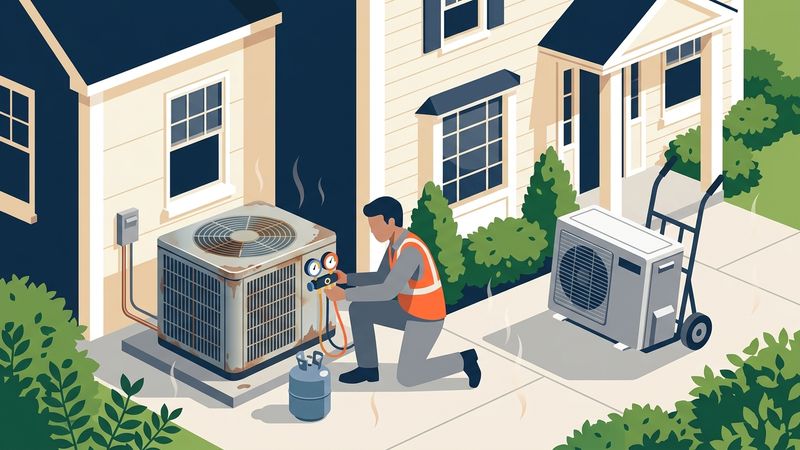
- Replace only the outdoor unit. The EPA allows replacing the condensing unit if your R-22 condenser breaks or is damaged, as long as the new unit meets regional efficiency standards. A technician still needs to confirm it is compatible with your indoor equipment. See our AC condenser repair and installation page.
- Replace the system with R-454B. According to Carrier, R-454B has zero ozone depletion potential and a global warming potential (GWP) of 466. Learn more about R-22 replacement and R-454B installation, or read our guide to what an R-454B conversion involves.
R22 vs R410A vs R454B: does the 2026 news affect you?
You may have read that R-410A systems could no longer be installed after January 1, 2026. The EPA removed that installation deadline for systems using refrigerants above 700 GWP, as long as the equipment was made or imported before January 1, 2025. In practice, you may see quotes for both R-410A and R-454B equipment. Ask which refrigerant a proposed system uses and why it fits your home.
Why fall is the right time to plan, and when to call a pro
Once the cooling season ends, your AC is off and there is no heat-wave rush. That gives you time to compare options instead of deciding in a hurry with a dead system in July.
What you can safely do yourself:
- Read the condenser nameplate and note the install date.
- Write down symptoms from the summer: longer run times, weak or warm airflow, ice on the refrigerant lines, or hissing near the unit.
- Keep leaves and debris cleared from around the outdoor unit.
What needs a licensed professional: anything that touches refrigerant, including leak testing, recovery, recharging, retrofits and equipment replacement. Our background-checked, licensed technicians are backed by engineers on staff and 56 years of combined industry experience, and we serve homeowners throughout Ridgewood, NJ with upfront pricing (NJ Lic. #197400 & #1221100).
Frequently asked questions
Is it illegal to keep running an R-22 system?
No. The EPA does not require homeowners to replace existing equipment, and you can keep using and repairing your R-22 system.
Is R-22 refrigerant still available for repairs?
Yes, but only recycled, reclaimed or previously produced R-22 can be used. New R-22 has not been produced or imported in the U.S. since 2020.
Can I replace only my R-22 outdoor unit?
The EPA allows it if the R-22 condensing unit breaks or is damaged, provided the new unit meets regional efficiency standards. A technician should confirm compatibility with your indoor coil and air handler.
Need Air Conditioning Service in Ridgewood, NJ?
Call Heights Plumbing, Heating & Cooling at (201) 245-7772 or schedule online today!
Schedule Service